
Japanese knotweed
Reynoutria japonica
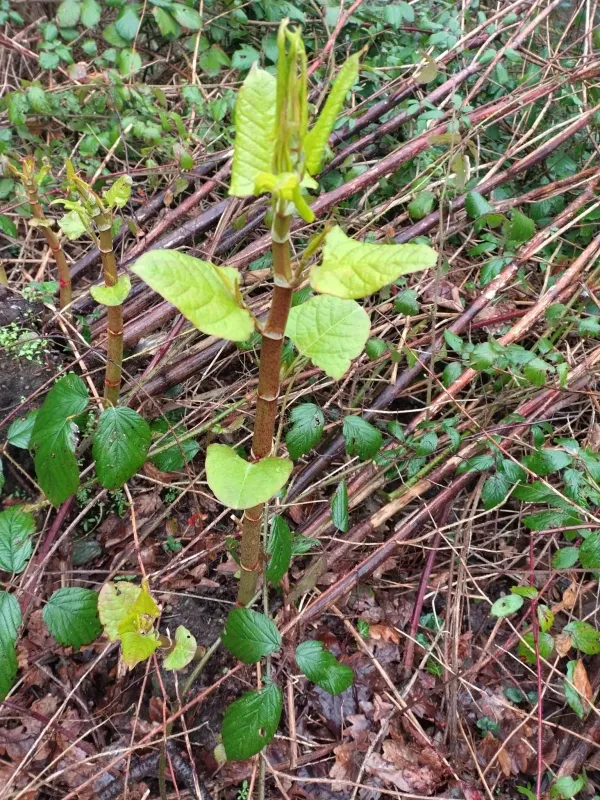
Description
How to tell it apart
Japanese knotweed, scientifically known as Reynoutria japonica, is a member of the Polygonaceae family. It is a vigorous perennial plant capable of forming dense, bamboo-like thickets that reach up to 3 meters in height.
The stems are hollow and upright, often speckled with reddish-purple spots. The leaves are broad and heart-shaped, arranged in a zig-zag pattern along the stems, which helps distinguish it from similar species.
The root system is the most destructive part of the plant. It consists of thick, woody rhizomes that can extend several meters horizontally and vertically, allowing it to survive harsh conditions.
Small, creamy-white flowers bloom in late summer, clustered in branching spikes. These flowers are highly attractive to bees and other pollinators, which often spreads the plant's influence indirectly.
During the winter, the aerial parts of the plant die back, leaving behind brown, brittle stems. However, the underground rhizome network remains alive, ready to push out new growth as soon as temperatures rise in spring.
Where it grows
This weed thrives in moist environments, frequently colonizing riverbanks, roadsides, waste grounds, and neglected agricultural land. It demonstrates extreme adaptability to various soil types, from clay to gravel.
In agricultural settings, Japanese knotweed often invades field margins and borders. Once established, it can aggressively spread into crop fields, quickly outcompeting native and cultivated plants for space and resources.
The plant's rapid growth rate allows it to cast a dense shade, preventing the development of any other vegetation. This makes it a formidable competitor in both pasture and arable crop systems.
Spread is almost exclusively vegetative. Even a small fragment of rhizome, as small as a fingernail, can produce a new plant if it is transported to a new location by farm machinery or floodwater.
Although the plant produces seeds, their viability and dispersal are less critical than the rhizome fragments. Consequently, human activity remains the primary driver of the plant's expansion across agricultural landscapes.
Harm it causes
The primary damage caused by Japanese knotweed is the total loss of land productivity. Its dense growth inhibits the cultivation of crops and significantly reduces the economic value of the infested soil.
It creates major obstacles for farming operations, as the thick, woody stems can easily damage or jam agricultural machinery like harvesters, plows, and mowers, leading to increased maintenance costs.
The plant's invasive nature causes physical damage to infrastructure, including irrigation pipes, drainage systems, and building foundations. Its rhizomes exert immense pressure, capable of cracking concrete surfaces.
The high resilience of knotweed necessitates repeated chemical and mechanical interventions, which increase the overall cost of production and environmental impact of herbicide use on the farm.
Additionally, Japanese knotweed acts as a host for various pests and pathogens, increasing the risk of disease transmission to nearby crops and complicating integrated pest management strategies.
How to control
Mechanical control is generally discouraged if used alone, as digging or plowing fragments the rhizomes and spreads the plant further. Any mechanical effort must be paired with careful disposal of all root material.
The most effective strategy is the use of systemic herbicides, particularly those containing glyphosate. Applications are best timed during late summer or early autumn to ensure the chemical is translocated into the deep rhizomes.
Consistent, long-term programs are essential for success. Repeated mowing to deplete the plant's energy reserves, followed by targeted chemical treatments, is the standard approach for eventual eradication.
For persistent infestations, a combination of deep soil cultivation to expose roots followed by chemical application has proven effective, though this often requires multiple seasons of diligent monitoring.
- Monitor field edges regularly for signs of new growth.
- Clean machinery thoroughly before moving from infested to clean fields.
- Utilize systemic herbicides specifically approved for woody perennials.
- Implement multi-year management plans for total eradication.
Taxonomy
- Latin name
- Reynoutria japonica
- Family
- Гречишка вьюнковая
- EPPO code
- POLCU