
Raoulia
Raoulia
Description
How to tell it apart
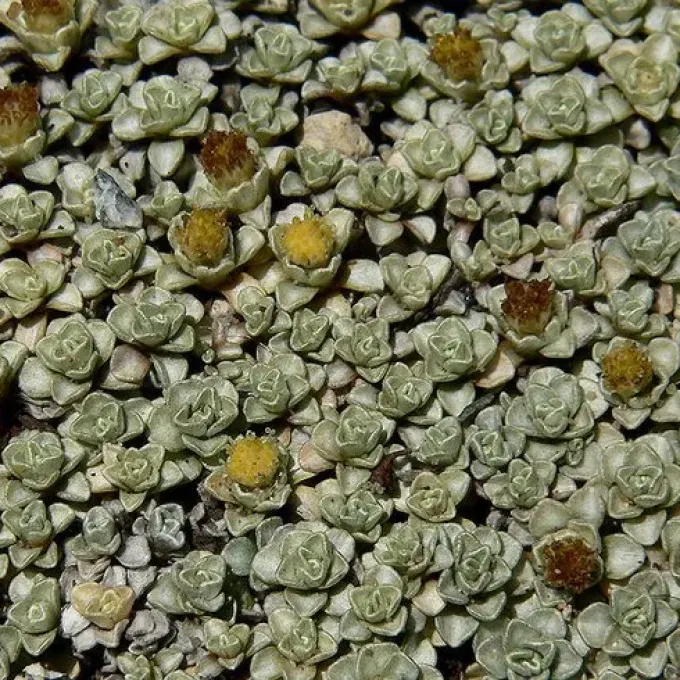
Raoulia is a genus of mat-forming plants belonging to the Asteraceae family. These plants are characterized by their cushion-like or carpet-like growth habit, which allows them to spread horizontally across the soil surface in dense clusters.
The leaves of Raoulia are typically small, imbricated, and densely covered in silver or greyish hairs, providing a distinct appearance that helps distinguish them from common weeds. This silvery pubescence is an adaptive feature to reduce water loss in harsh, sunny environments.
The root system is fibrous and generally shallow, allowing the plant to cling to rocky or gravelly substrates effectively. In its native environment, the plant grows in low-lying patches that can expand over several meters if left unchecked.
Flowering occurs in small, inconspicuous heads characteristic of the daisy family. While the flowers are not showy, they produce seeds that are easily dispersed, contributing to the plant's ability to colonize new areas.
Due to its flat, low-profile growth, Raoulia can be overlooked during early stages of infestation. Careful inspection is required to identify the distinct foliage texture before it forms expansive mats.
Where it grows
Raoulia is primarily native to New Zealand, thriving in alpine and subalpine regions. It is highly adapted to open, well-drained, and often gravelly soils where sunlight is abundant and competition from taller vegetation is limited.
In agricultural contexts, it often invades poorly managed pastures or degraded land with sparse ground cover. It is particularly persistent in areas where the soil has been disturbed or compacted, offering a niche for this hardy weed.
The weed prefers areas with low humidity and high exposure to wind, common in mountain environments. It does not compete well in lush, high-fertility croplands where dense shading occurs.
It acts as a colonizer on barren ground, stabilizing exposed surfaces. However, its presence in managed fields is usually an indicator of low competitive pressure from crops or pasture grasses.
Raoulia can survive in cooler climates, making it a persistent presence in upland areas where more sensitive crops may struggle to establish themselves effectively.
Harm it causes
The primary harm caused by Raoulia is its physical inhibition of seed germination. By creating dense mats on the soil surface, it blocks sunlight and prevents crop seeds from establishing contact with the soil.
It exerts significant competition for moisture and soil nutrients, particularly in the upper soil profile, which can stunt the growth of young crops or desirable pasture grasses.
On grazing lands, Raoulia is considered undesirable because it is generally unpalatable to livestock. Its presence effectively reduces the carrying capacity of the pasture by occupying space that would otherwise be used by forage.
The dense mat structure can also lead to issues with field uniformity, making it difficult to maintain consistent crop quality and complicating mechanical harvesting processes if the weed spreads into production areas.
The ability of Raoulia to create a long-term seed bank in the soil means that once established, the weed requires a sustained, multi-year management strategy to fully eradicate from a specific site.
How to control
Mechanical control is often the most effective first step. Deep cultivation, such as plowing or rigorous disking, is necessary to break up the dense mat and destroy the established root systems of the weed.
In pasture management, improving soil fertility to encourage the growth of vigorous forage species is essential. A dense cover of desirable grass will naturally shade out Raoulia, limiting its ability to spread.
Chemical control with systemic herbicides can be effective if applied during active growth stages. Due to the hairy nature of the leaves, it is recommended to use surfactants to improve herbicide uptake and efficacy.
Monitoring field edges and disturbed patches is crucial for early detection. Spot-treatment with herbicides or physical removal of small patches can prevent larger infestations from forming.
- Deep plowing to disrupt the mat growth.
- Using systemic herbicides with surfactant additives.
- Increasing pasture density to suppress weed colonization.
- Manual removal of initial, isolated patches.
Taxonomy
- Latin name
- Raoulia
- Family
- Сложноцветные (астровые)
- EPPO code
- RAOSS