
Pseudognaphalium undulatum
Pseudognaphalium undulatum
Description
How to tell it apart
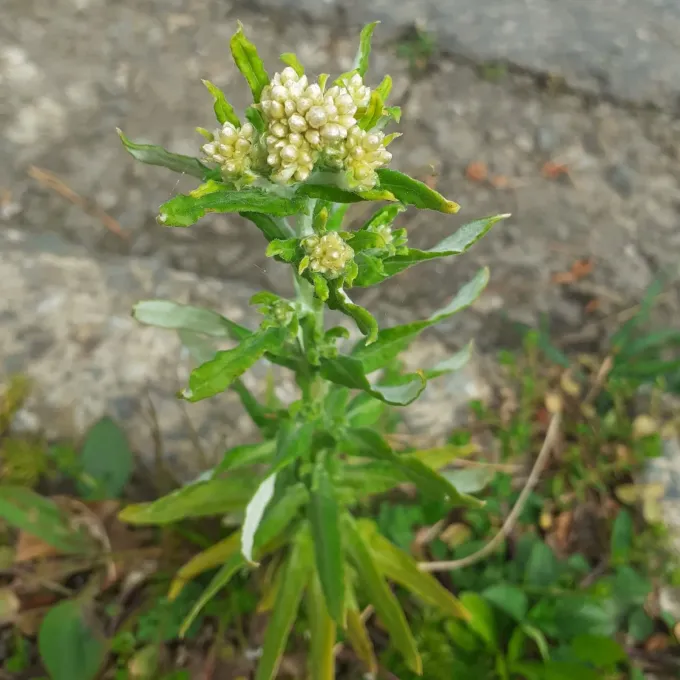
Pseudognaphalium undulatum is a perennial or biennial herb belonging to the Asteraceae family. It is easily identified by the dense, white-woolly tomentose indumentum covering its stems and leaves.
The leaves are linear-lanceolate, possessing characteristic undulated or wavy margins, which serves as a primary morphological trait for field identification of this species.
The plant produces numerous small, yellowish to cream-colored flower heads organized in dense corymbose inflorescences at the tips of its stems.
As a member of the Gnaphalieae tribe, it produces achenes equipped with a pappus, facilitating long-distance seed dispersal via wind, which contributes to its aggressive colonization.
The root system is fibrous and hardy, allowing the plant to survive in diverse soil conditions and regenerate effectively after mechanical disturbance.
Where it grows
This weed typically colonizes disturbed sites, including roadsides, wasteland, and abandoned fields, often acting as a pioneer species in open, sunny environments.
In agricultural settings, it is commonly found in row crops, cereals, and fallow land, where the lack of competition or intensive tillage creates ideal conditions for its establishment.
It exhibits high ecological plasticity, thriving in a variety of substrates ranging from loamy fields to rocky or sandy soils, which makes it a persistent nuisance.
Infestations often start at the field edges, where the weed takes advantage of the margin effect before spreading into the inner parts of the cultivated area.
Its presence is often a strong indicator of soil compaction or a lapse in standard crop rotation practices, highlighting the need for better field management.
Harm it causes
The primary damage caused by Pseudognaphalium undulatum is the intense competition with crops for essential nutrients, water, and sunlight, particularly during the critical early growth stages.
By forming dense patches, the weed shades young crop seedlings, significantly reducing their photosynthetic efficiency and slowing down the overall crop development.
The dense vegetative cover of the weed alters the micro-climate within the crop rows, increasing humidity and providing a conducive environment for various fungal pathogens.
During the harvest period, the weed biomass can lead to mechanical harvesting difficulties, clogging machinery and increasing the moisture content of the harvested grain.
In addition to physical competition, the presence of these weeds reduces the overall land-use efficiency and can harbor pests or diseases that may spread to the main crop.
How to control
Integrated weed management is crucial; deep autumn plowing is recommended to bury seeds and damage the root system, preventing successful overwintering and early spring growth.
Chemical control involving systemic herbicides applied during the early vegetative phase is highly effective, especially when targeted at young rosettes.
Mechanical control, such as inter-row cultivation, should be timed to disturb the soil surface before the plant reaches the flowering stage, thus preventing seed production.
Crop rotation including dense-canopy crops helps shade out the weed, as Pseudognaphalium undulatum struggles to compete in low-light environments created by successful crops.
- Timely mowing of field borders.
- Application of selective herbicide programs.
- Use of certified weed-free seed.
Taxonomy
- Latin name
- Pseudognaphalium undulatum
- Family
- Сложноцветные (астровые)
- EPPO code
- GNAUN