
Cotton-batting cudweed
Pseudognaphalium stramineum
Description
How to tell it apart
Cotton-batting cudweed (Pseudognaphalium stramineum) is a member of the Asteraceae family. It is recognized as a persistent weed species that frequently invades disturbed landscapes and agricultural areas.
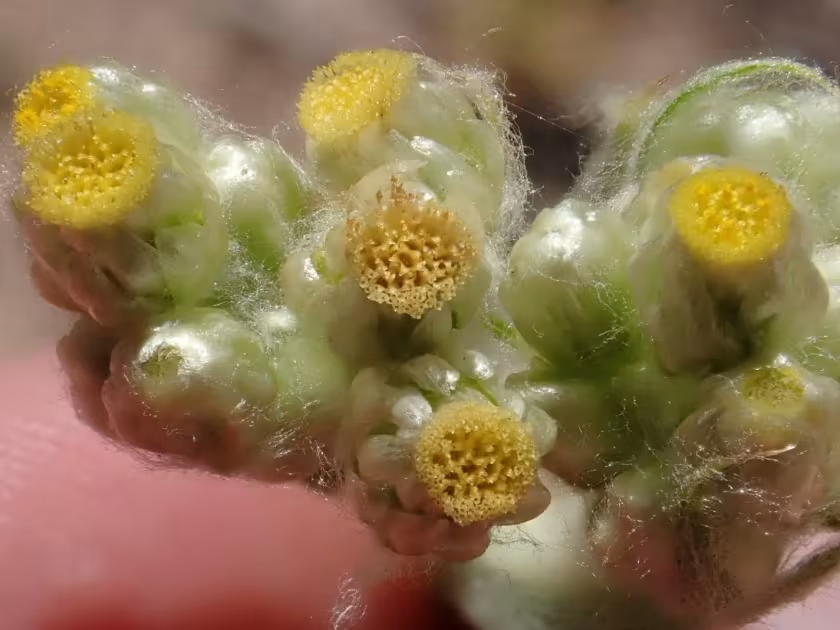
The plant is easily identified by its dense, woolly, or cotton-like pubescence covering the stems and leaves, which gives it a distinct whitish or silver appearance.
Its flowers are arranged in small heads, typically grouped into dense, straw-colored clusters, justifying its specific epithet stramineum (meaning straw-colored).
As an annual or biennial herb, it propagates via a prolific amount of wind-dispersed seeds equipped with a feathery pappus for long-distance travel.
The root system consists of a sturdy taproot, allowing the plant to anchor itself firmly and access deeper soil moisture in competition with crops.
Where it grows
Native primarily to North America, this species thrives in disturbed soil conditions, including roadsides, pastures, waste areas, and fallow agricultural fields.
In cropping systems, it poses a threat to various field crops and vegetables, quickly colonizing areas where soil tillage or crop cover is inconsistent.
It prefers sunny, open environments and is highly adaptable to various soil textures, from sandy to heavy loam, reflecting its invasive capability.
The plant demonstrates significant drought tolerance, allowing it to persist and spread during dry seasons when other competing vegetation might be stressed.
Its ability to establish quickly after soil disturbance makes it a common colonizer of agricultural margins and poorly managed field patches.
Harm it causes
The primary impact of this weed is the competitive suppression of crops, where it siphons away limited water, nutrients, and sunlight from early crop growth stages.
Severe infestations can lead to significant yield losses, as the weed effectively chokes out crop seedlings and competes for space within the row.
The presence of dense weed populations hampers mechanized farming operations, causing delays and increasing the costs associated with harvesting and cleaning the final crop.
Cotton-batting cudweed can serve as a host for secondary pests and diseases, which potentially transfer to adjacent susceptible crops, increasing production risks.
Contamination of harvested grain with its small, light seeds can downgrade the quality of agricultural produce, necessitating extra processing steps.
How to control
Integrated weed management is essential for successful control, combining preventive cultural practices with targeted chemical applications.
Cultural control strategies include deep primary tillage to bury seeds at depths that inhibit germination, alongside regular inter-row cultivation during the growing season.
Maintaining a robust crop rotation prevents the weed from establishing a consistent growth cycle, effectively disrupting its population buildup over time.
Chemical control involving systemic herbicides is most effective when applied during the vegetative stage, before the plant reaches the flowering and seed-dispersal phase.
- Mowing or hand-pulling at the edges of fields to prevent seeds from blowing into the crop area.
- Using high-quality, weed-free seeds to prevent initial introduction into the field.
- Spot-treating specific infested patches with selective herbicides to minimize total chemical usage.
Taxonomy
- Latin name
- Pseudognaphalium stramineum
- Family
- Сложноцветные (астровые)
- EPPO code
- QGPST