
Rabbit tobacco
Pseudognaphalium obtusifolium
Description
How to tell it apart
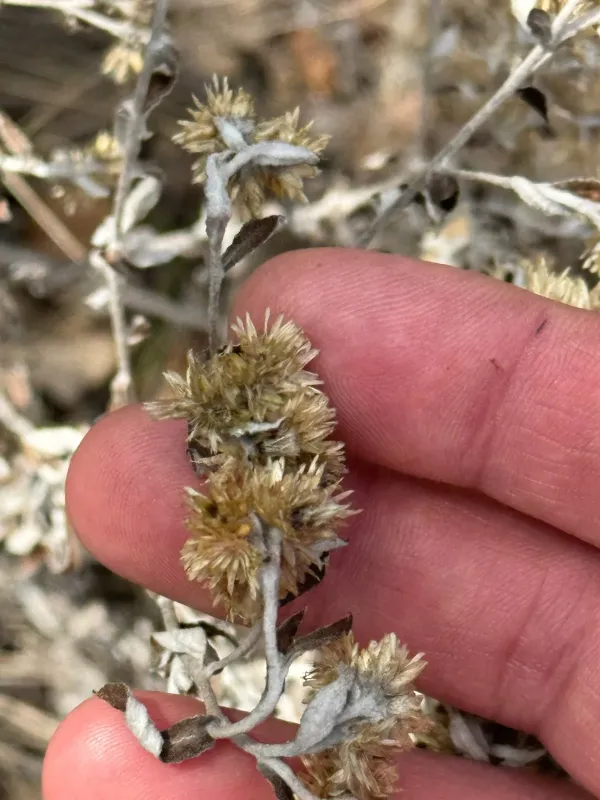
Rabbit tobacco (Pseudognaphalium obtusifolium) is a member of the Asteraceae family. It is a perennial herbaceous plant characterized by its dense, white, woolly foliage on the stems and leaves.
The leaves are lance-shaped with a blunt tip, which gives the species its specific name. The upper surface is dark green, while the underside is covered with a soft, greyish pubescence.
The flowers are arranged in small, dense, corymb-like inflorescences at the tips of the shoots. The florets are generally yellowish or off-white in color.
The plant is known for its distinct, fragrant aroma due to the presence of essential oils. It possesses a robust root system that aids in its survival and competitive growth.
Propagation occurs primarily through wind-dispersed seeds, which are equipped with feathery pappus, allowing them to travel long distances from the parent plant.
Where it grows
This weed thrives in open, sunny locations. It is commonly found in sandy soils, dry meadows, along roadsides, and on abandoned agricultural lands.
In crop production, it acts as an invasive species that quickly occupies available space, particularly in grain fields and perennial forage crops.
The plant adapts well to disturbed environments, allowing it to colonize field edges and uncultivated strips before spreading into the main crop areas.
Its ecological tolerance enables it to withstand periods of drought, which facilitates its spread throughout temperate regions.
It often forms dense, monoculture-like patches that prevent the natural establishment of beneficial native vegetation or crops.
Harm it causes
The primary damage caused by this weed is the intense competition for soil moisture and nutrients, which depletes the resource base for cultivated crops.
Dense colonies create significant shading, which slows down the germination and early development of crops, leading to uneven stands and reduced yield.
The presence of the plant during harvest complicates operations, as its fibrous biomass can clog combine harvesters and increase the moisture content of the harvested grain.
It can also serve as an alternate host for various insect pests and fungal pathogens, potentially increasing the risk of disease outbreaks in adjacent crops.
If left unmanaged, the weed can significantly reduce overall profitability due to the high costs of mechanical removal and yield losses.
How to control
A comprehensive control strategy includes deep autumn plowing to disrupt the root systems and bury the seeds, reducing the potential for emergence in the next season.
Crop rotation remains a fundamental practice, using vigorous, fast-growing crops that can outcompete the weed for sunlight and space.
Chemical control involves the use of systemic herbicides applied during the plant's active growth stage, prior to flowering, to ensure maximum absorption.
For non-crop areas, broad-spectrum herbicides like glyphosate are effective for controlling mature populations and preventing further spread into adjacent fields.
- Frequent mowing of field margins to prevent seed production.
- Integrated pest management (IPM) to monitor infestation levels.
- Ensuring seed lot purity to prevent introduction to new fields.
Taxonomy
- Latin name
- Pseudognaphalium obtusifolium
- Family
- Сложноцветные (астровые)
- EPPO code
- GNAOB