
Macoun's cudweed
Pseudognaphalium macounii
Description
How to tell it apart
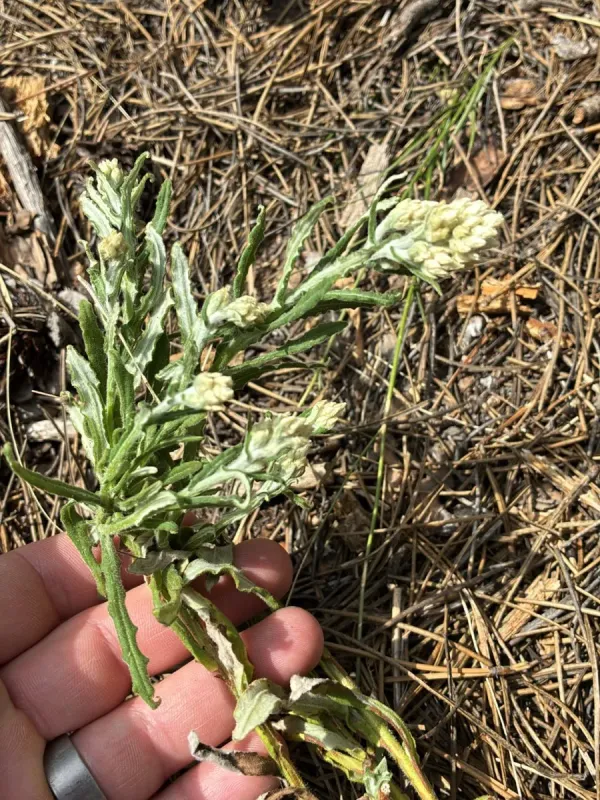
Macoun's cudweed is an annual herbaceous plant belonging to the Asteraceae family. It is characterized by an upright stem that grows between 30 and 80 cm in height, covered in a dense, white, woolly tomentum.
The leaves are alternate, linear-lanceolate, and sessile, often with revolute margins. A notable feature is the stark visual contrast between the dark green upper surface and the white, felty underside.
The inflorescences consist of numerous small flower heads arranged in corymbose clusters at the stem tips. The flowers are yellowish and enclosed by dry, papery bracts that give the plant a distinctively dried appearance.
The fruit is a minute achene equipped with a pappus, which allows the seeds to be easily dispersed by the wind over long distances. This adaptation makes it an efficient colonizer of new areas.
The plant typically completes its life cycle within a single season. Seeds are capable of germinating at different times of the growing season, provided there is adequate moisture and soil disturbance.
Where it grows
Native to North America, Macoun's cudweed has established itself in various regions with temperate climates. It typically inhabits dry, sandy, or disturbed soil types where competition from other plants is minimal.
The weed is frequently found along roadsides, in waste areas, gravel pits, and fallow fields. In agricultural settings, it tends to colonize thinning crop stands or uncultivated field margins.
The plant exhibits high ecological plasticity, thriving in soils with low organic matter. It avoids waterlogged areas, preferring well-drained and properly aerated substrates for optimal development.
In agricultural ecosystems, it poses a challenge to vegetable and row crop production by occupying empty spaces between crop rows. It often spreads into fields from adjacent non-cropped buffer zones.
Dispersal is primarily wind-driven, allowing the species to rapidly infest large areas of arable land immediately following soil cultivation or clearing activities.
Harm it causes
The primary damage caused by Macoun's cudweed is through direct competition with crops for limited resources, including sunlight, soil moisture, and essential plant nutrients during early growth stages.
When present in high densities, the weed can significantly reduce crop yields by shading out smaller or slow-growing plants, which is particularly detrimental to vegetable and horticultural crops.
In pastures and rangelands, the presence of this weed degrades forage quality. While not highly toxic, its fibrous, woolly nature reduces the overall palatability and nutritional value of hay.
Macoun's cudweed creates physical interference during mechanized farming operations and harvesting. The accumulation of dry, brittle stalks at the end of the season can also increase fire risks.
Furthermore, the species may act as an alternative host for various agricultural pests and viral pathogens, which can then migrate to adjacent crops, complicating integrated pest management.
How to control
The most effective management strategy involves preventing the production and dispersal of seeds by removing or destroying the plants before they reach the flowering stage.
Agronomic practices, such as deep autumn plowing and timely inter-row cultivation, are essential to kill seedlings and suppress the establishment of mature plants within the cropping cycle.
Implementing crop rotations that include fast-growing or dense-canopy crops helps shade the soil surface, effectively suppressing the germination and growth of this sun-loving weed.
Chemical control can be achieved using appropriate systemic herbicides. The choice of herbicide must be tailored to the specific crop being grown or the non-crop area being managed.
- Mow field borders regularly to prevent seed set.
- Use systemic herbicides for pre-planting weed control.
- Maintain optimal crop density to outcompete weeds.
- Monitor fields frequently for early detection of infestation patches.
Taxonomy
- Latin name
- Pseudognaphalium macounii
- Family
- Сложноцветные (астровые)
- EPPO code
- QGPMA