
Jersey cudweed
Pseudognaphalium luteoalbum
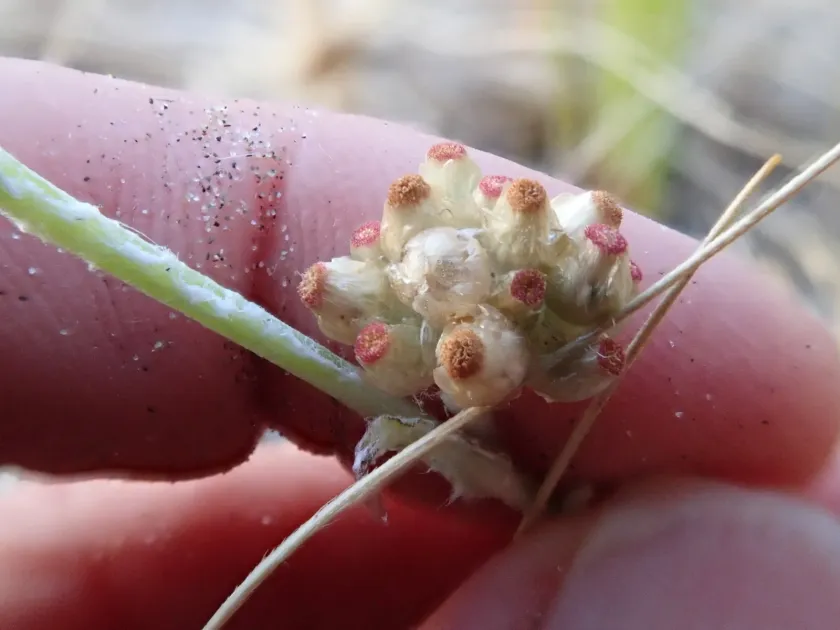
Description
How to tell it apart
Jersey cudweed (Pseudognaphalium luteoalbum) is an annual herbaceous plant belonging to the Asteraceae family. It typically grows to a height of 10 to 50 centimeters, featuring an upright or ascending stem that often branches from the base.
The leaves are alternate, linear-lanceolate, and sessile, covered with a dense, white-to-grayish felt-like tomentum. This silvery-white woolly covering is the most distinctive feature for field identification.
The inflorescences are dense, corymbose heads clustered at the ends of the stems. The bracts of the flower heads are dry and scarious with a yellowish-white appearance, which is reflected in its scientific name.
It propagates exclusively through seeds, which are equipped with a pappus (hairy tuft). This allows them to be easily dispersed by wind over long distances, leading to rapid infestation of agricultural lands.
The plant blooms from June to September. Its overall appearance is highly characteristic, making it distinct from many other weed species found in agricultural settings.
Where it grows
Jersey cudweed is commonly found in arable fields, fallow lands, roadsides, and disturbed sandy soils. It thrives in open environments where there is minimal competition from denser vegetation.
Within crop fields, it frequently infests vegetable crops, orchards, and row-cropped plantations. It is highly adaptable to various soil types, particularly those with light, sandy textures or compacted layers.
The species is widespread in warmer regions and can rapidly colonize areas after cereal harvesting. It often exploits moist areas, including irrigated fields, where it can grow vigorously and outcompete young seedlings.
It also appears in pastures and degraded rangelands, where its presence can reduce the quality of fodder and displace valuable forage grasses due to its rapid growth cycle.
The weed acts as a colonizer of disturbed sites, quickly establishing itself after soil cultivation, making it a persistent issue in conventional farming systems.
Harm it causes
The primary harm caused by Jersey cudweed is its intense competition with crops for essential soil nutrients, water, and sunlight. During the critical stages of crop emergence, it can significantly hinder development.
By forming dense clusters, the weed shades out crop seedlings, leading to reduced plant density and uneven stands, which ultimately results in lower yields and poor crop quality.
Contamination of harvested grain with cudweed seeds increases processing costs. Removing these small, hairy seeds from the bulk commodity requires specialized machinery and adds unnecessary expense for producers.
The plant serves as an alternative host for various agricultural pests and fungal pathogens, which can migrate to neighboring crops, thereby necessitating additional pesticide applications.
Mechanical operations, such as inter-row cultivation, are often hindered by the presence of this weed. Its rapid recovery from mechanical disturbances can lead to increased costs for maintenance and weeding.
How to control
Effective management of Jersey cudweed requires an integrated approach that combines cultural practices and chemical control. The primary goal should be to prevent the production and dispersal of seeds.
Cultural practices include deep plowing to bury seeds, regular inter-row cultivation to disturb the root system of young plants, and the implementation of crop rotations that favor more competitive, dense-canopy crops.
Chemical control involves the use of selective herbicides applied during the rosette stage of the weed. Treatments are most effective when the weed is actively growing and vulnerable to systemic active ingredients.
In fallow periods or prior to planting, non-selective herbicides such as glyphosate can provide high levels of control, ensuring that the existing seed bank is reduced over time through consistent management.
- Strict adherence to crop rotation to disrupt weed cycles.
- Use of weed-free, high-quality certified seeds.
- Tank-mixing herbicides to ensure broader spectrum control and minimize resistance development.
Taxonomy
- Latin name
- Pseudognaphalium luteoalbum
- Family
- Сложноцветные (астровые)
- EPPO code
- GNALA