
Jersey cudweed
Pseudognaphalium affine
Description
How to tell it apart
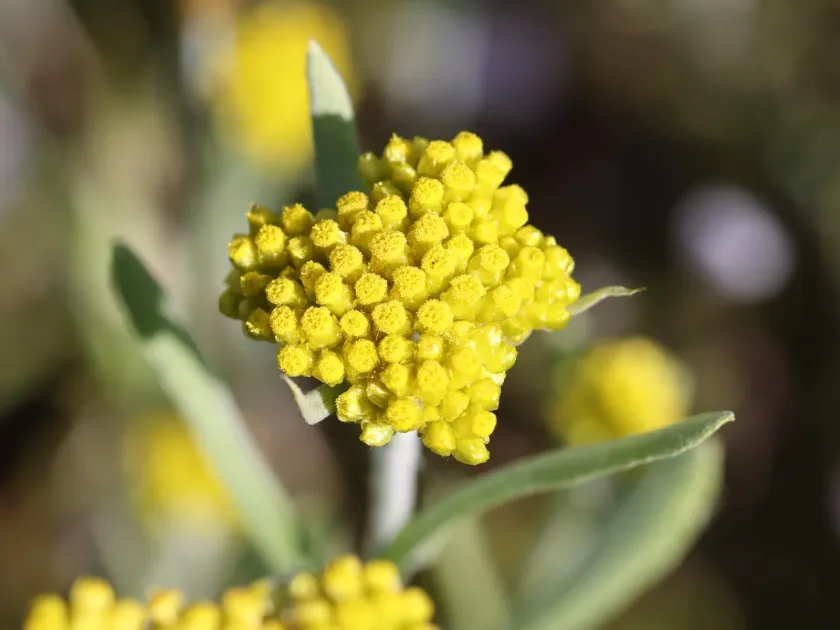
Jersey cudweed (Pseudognaphalium affine) is a herbaceous plant belonging to the Asteraceae family. It is easily identified by the dense, white, woolly tomentum that covers all its vegetative parts, giving it a distinctive silver appearance.
The stems are typically erect, reaching 15–40 cm in height, and often branch from the base. Leaves are alternate, oblong or spatulate, with entire margins, and are thickly covered in hairs.
The inflorescences consist of small flower heads clustered in dense corymbs or head-like structures at the top of the stems. The bracts of the flower heads are dry, membranous, and yellowish or whitish.
The fruit is a minute, oblong achene equipped with a feathery pappus, allowing it to be easily dispersed by the wind, which facilitates rapid colonization of surrounding areas.
Seedlings show the same silvery-white pubescence characteristic of adult plants, which helps in identifying and differentiating the species during the early stages of crop development.
Where it grows
This weed is native to East Asia, where it is commonly found in a variety of environments. It displays a high degree of adaptability to different soil types and environmental conditions.
It prefers open, sunlit spaces and is frequently found on abandoned agricultural lands, along roadsides, on slopes, and in disturbed areas where vegetation cover is sparse.
In agricultural settings, it often infests grain crops, vegetable fields, and pastures. It is particularly persistent in fields with compacted soil that have not been managed for a few seasons.
While it thrives in moderate moisture, the plant demonstrates a fair amount of drought tolerance, which allows it to survive in arid regions where other weeds might perish.
The weed acts as a pioneer species in disturbed soils, quickly establishing itself after tilling or other mechanical disruptions, which makes it a persistent issue in poorly managed fields.
Harm it causes
The primary damage caused by Jersey cudweed is intense competition with crops for water, nutrients, and sunlight, which significantly reduces the growth rates and yield potential of the main crop.
In dense infestations, the weed creates significant shading for crop seedlings, hindering their initial development and potentially causing a decrease in plant stand density.
The woolly hairs on the leaves can trap dust and moisture, creating a micro-environment that may favor the growth of various plant pathogens that could potentially spread to neighboring crops.
In grazing pastures, its presence is undesirable as livestock generally avoid consuming the hairy foliage, leading to a reduction in the overall forage quality and palatable biomass available.
The accumulation of seeds in the soil seed bank is a long-term issue. Once established, the population requires sustained efforts over several years to deplete the seed bank through regular management.
How to control
Mechanical control, such as consistent tillage and deep plowing, is crucial for limiting the population before it reaches the flowering stage and produces viable seeds.
Good agricultural practices, including crop rotation and the use of cover crops, help to shade out the weed and exhaust its ability to regenerate within a specific field.
Chemical control is effective using systemic herbicides, particularly on field edges or fallow land. Selective herbicides can be used within crops, provided the timing matches the weed's vulnerable stage.
Hygiene practices are essential; cleaning machinery thoroughly after working in infested fields prevents the transport of the small, wind-dispersed seeds to non-infested areas.
- Regular mowing of fallow land to prevent seed production.
- Use of pre-emergent herbicides in high-infestation areas.
- Manual removal for small patches to ensure complete root removal.
Taxonomy
- Latin name
- Pseudognaphalium affine
- Family
- Сложноцветные (астровые)
- EPPO code
- GNAAF