
Pseudelephantopus spicatus
Pseudelephantopus spicatus
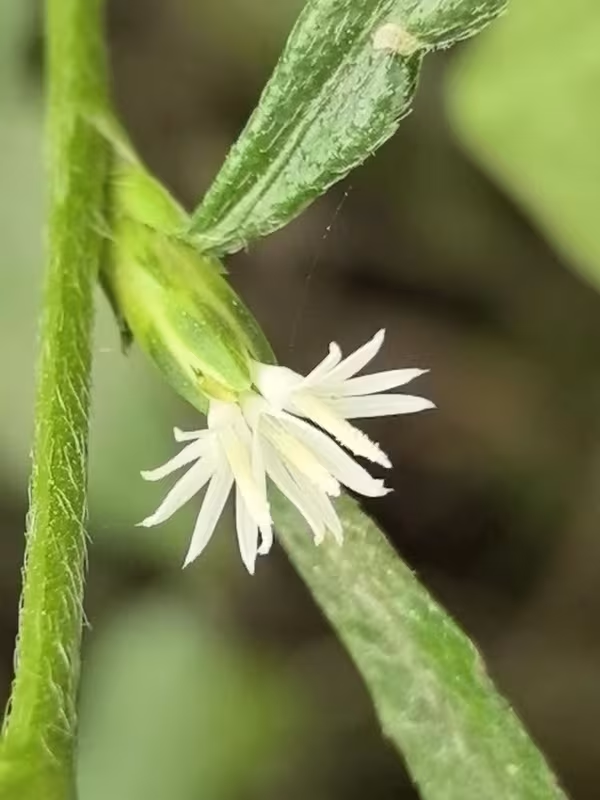
Description
How to tell it apart
Pseudelephantopus spicatus is a plant species belonging to the Asteraceae family. It is a perennial herbaceous plant with erect stems reaching heights of 30 to 80 cm.
The leaves are elongated, often forming a basal rosette, while stem leaves are arranged alternately. Leaf margins can be serrated or entire, and the surface is frequently pubescent.
Inflorescences consist of dense, spike-like clusters of small flower heads. The flowers are typically white or light violet, which gives the plant a distinct appearance during the blooming phase.
The plant features a robust taproot system capable of regeneration even after mechanical damage, ensuring high survival rates in various soil conditions.
It reproduces both by seeds and vegetatively, forming new shoots from root buds, which makes identification and early removal challenging for agricultural producers.
Where it grows
This species is widely distributed in tropical and subtropical regions. It is commonly found in fields, pastures, roadsides, and as part of ruderal vegetation.
It prefers moist, well-lit areas but exhibits significant plasticity toward different soil types, including sandy and clay substrates.
In agroecosystems, the weed poses a threat to row crops, sugarcane plantations, coffee, and vegetable crops. Its harm is manifested in the rapid colonization of open space.
Within crops, it competes aggressively with cultivated plants for nutrients and moisture, often outgrowing them during critical development stages.
It frequently occurs in weed communities on fallow lands, from which it can spread rapidly to cultivated fields.
Harm it causes
The primary damage results from the suppression of crop growth due to intense competition for light, water, and mineral nutrients.
Dense thickets of the weed hinder mechanical field operations and harvesting, significantly reducing the efficiency of agricultural machinery.
The weed can serve as a reservoir for various pests and diseases, which may subsequently spread to agricultural crops, complicating phytosanitary management.
Its biological ability to form a dense canopy leads to the shading of low-growing crops, causing etiolation and a overall reduction in crop yield.
Seeds are easily dispersed by wind, leading to the rapid infestation of large areas in a very short period.
How to control
Agronomic control methods include regular deep soil cultivation aimed at extracting and destroying the root system of the weed.
Crop rotation is an effective strategy, incorporating high-density crops that create strong competition for light and suppress weed seedling emergence.
Applying mulch in crop rows significantly reduces seed germination and the development of young Pseudelephantopus spicatus rosettes.
Chemical control involves the use of broad-spectrum systemic herbicides, although their application must be strictly regulated according to the crop growth stage.
- Timely mowing before the flowering phase to prevent seed set.
- Application of pre-emergence soil herbicides.
- Targeted application of glyphosate-based herbicides in areas with high infestation density.
Taxonomy
- Latin name
- Pseudelephantopus spicatus
- Family
- Сложноцветные (астровые)
- EPPO code
- PSESP