
Psephellus bellus
Psephellus bellus
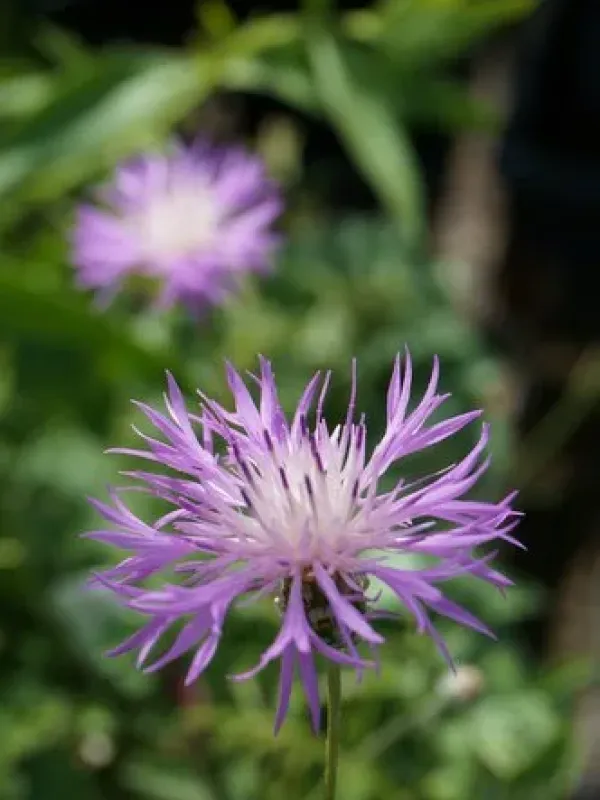
Description
How to tell it apart
Psephellus bellus is a herbaceous perennial plant belonging to the Asteraceae family. It is often distinguished by its aesthetic similarity to cornflowers, although it acts as a persistent weed in agricultural landscapes.
The plant features an erect, leafy stem that typically grows to a height of 20–50 cm. Its leaves are covered in fine, grayish hairs, an adaptation that helps the plant survive in dry, high-sunlight environments.
The flower heads are solitary and consist of tube-shaped and trumpet-shaped florets. The vibrant purple or pink color of the petals makes it easily recognizable during the flowering phase.
Its root system is characterized by a deep, sturdy taproot that allows the plant to access moisture in deep soil layers, ensuring survival even during severe drought conditions.
It propagates via both seed dispersal and vegetative growth, as the root system can develop new shoots, making it a difficult weed to eradicate once it establishes in a field.
Where it grows
Psephellus bellus thrives in open, sunny locations. It is commonly found in steppe zones, rocky slopes, and dry meadows where sunlight is abundant and competition for moisture is high.
In agricultural settings, it infests cereal fields, legume crops, and perennial grass fields. It is particularly persistent in fields left fallow or those with minimal soil disturbance.
The weed demonstrates a high tolerance for nutrient-poor, sandy, or rocky soils, allowing it to thrive where other plants might struggle to grow.
Roadsides and the edges of cultivated fields often serve as reservoirs, from which seeds are blown by the wind into productive croplands, initiating new infestations.
Its ability to adapt to diverse climatic conditions makes it a resilient inhabitant of field borders, where it can remain undisturbed by routine field operations.
Harm it causes
The primary damage caused by Psephellus bellus is its intense competition with crops for essential resources, specifically soil moisture, nutrients, and sunlight during the growing season.
By capturing moisture through its deep taproot, it deprives cultivated plants of water, leading to reduced yields, particularly in arid or semi-arid regions.
The presence of this weed interferes with mechanized harvesting operations, often leading to increased impurities in the harvested grain and lowering its market value.
It can serve as a host for various pests and fungal diseases common to the Asteraceae family, which increases the pressure on crop health and necessitates additional pesticide applications.
In cases of heavy infestation, farmers may experience significant yield reductions, impacting the overall profitability of the field and increasing management costs over time.
How to control
Effective control starts with deep primary tillage, such as fall plowing, which is essential to sever the taproots and deplete the nutrient reserves of the plant.
Crop rotation remains a fundamental strategy; alternating between diverse crop types can break the life cycle of the weed and reduce its population density in the soil.
In row crops, mechanical cultivation between the rows is highly effective at destroying seedlings and younger plants before they reach their reproductive phase.
Chemical control involving systemic herbicides is recommended during the active growth stage, specifically when the plant is in the rosette stage for maximum absorption.
- Use of glyphosate-based herbicides on fallow ground to control perennial root systems.
- Application of selective broad-leaf herbicides in cereal crops.
- Timely mowing of field margins to prevent seed production and spread.
Taxonomy
- Latin name
- Psephellus bellus
- Family
- Сложноцветные (астровые)
- EPPO code
- QQHBE