
Hairy purslane
Portulaca pilosa
Description
How to tell it apart
Hairy purslane (Portulaca pilosa) belongs to the Portulacaceae family. It is an annual, succulent herbaceous plant that is often mistaken for an ornamental species.
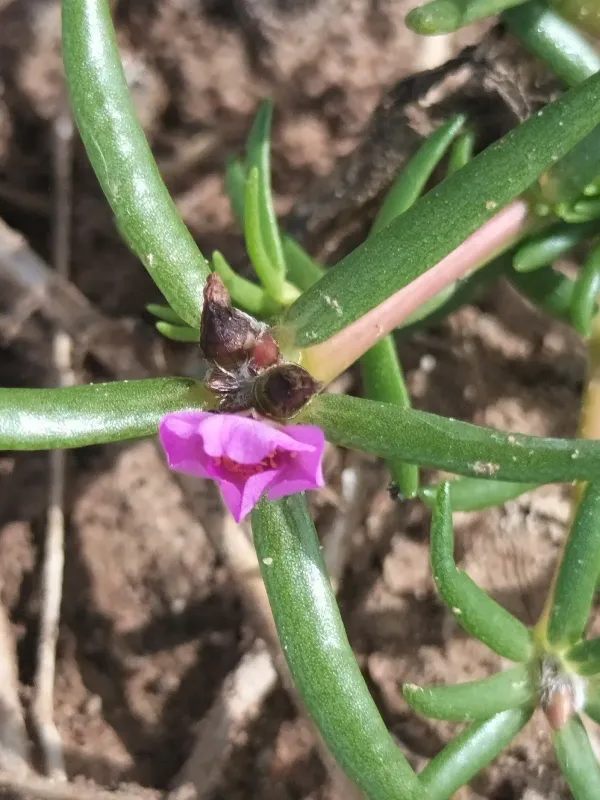
The key identification feature is the presence of fine, conspicuous hairs in the leaf axils. The stems are prostrate or ascending and often have a distinct reddish hue.
The leaves are fleshy, cylindrical to oblong, and arranged alternately. The root system is shallow but quite tenacious, allowing the plant to thrive in dry conditions.
The flowers are small, ranging from pink to purple, and open only in bright sunlight. The fruit is a small capsule that splits open to release a vast number of seeds.
Biologically, the plant is highly resilient and capable of spreading via both seeds and vegetative fragments if they come into contact with moist soil.
Where it grows
This weed prefers well-lit, dry, and sandy areas. It is commonly found on neglected land, along roadsides, and in open fields with minimal competition.
In agricultural settings, hairy purslane causes significant issues in row crops, vegetable plantations, and vineyards, where it quickly occupies empty spaces.
It is a thermophilic plant, making its appearance most frequent during the summer months when soil temperatures reach their peak.
It can also colonize saline soils and wasteland areas where other plant species struggle to survive due to poor nutrient conditions.
Its widespread distribution is driven by extreme drought tolerance and its ability to grow in nutrient-poor environments.
Harm it causes
The primary damage caused by hairy purslane is its intense competition for water and nutrients, which is especially critical in arid agricultural regions.
Because of its rapid growth and creeping habit, it forms dense mats that shade out and suppress the development of young crop seedlings.
The weed acts as a reservoir for various viral diseases and pests, which can easily migrate to healthy agricultural crops.
A single plant produces thousands of seeds, leading to a rapid accumulation of a persistent seed bank in the soil over several seasons.
The presence of this weed reduces overall yields and makes mechanical harvesting difficult, particularly in low-growing crops.
How to control
Agrotechnical measures include frequent inter-row cultivation and hand pulling, which must be executed before the plant enters its seed-setting stage.
It is crucial not to leave pulled stems on the soil surface, as they are capable of re-rooting quickly if minimal moisture is available.
Chemical control is complicated by the plant's succulent nature; therefore, systemic herbicides are often required for effective eradication.
- Regular inter-row tilling to disrupt root development.
- Use of pre-emergent herbicides to stop seed germination.
- Implementation of crop rotation to reduce weed pressure.
A combination of mechanical removal and targeted herbicide application provides the best long-term control against this stubborn weed species.
Taxonomy
- Latin name
- Portulaca pilosa
- Family
- Портулаковые
- EPPO code
- PORPI