
Camphorweed
Pluchea camphorata
Description
How to tell it apart
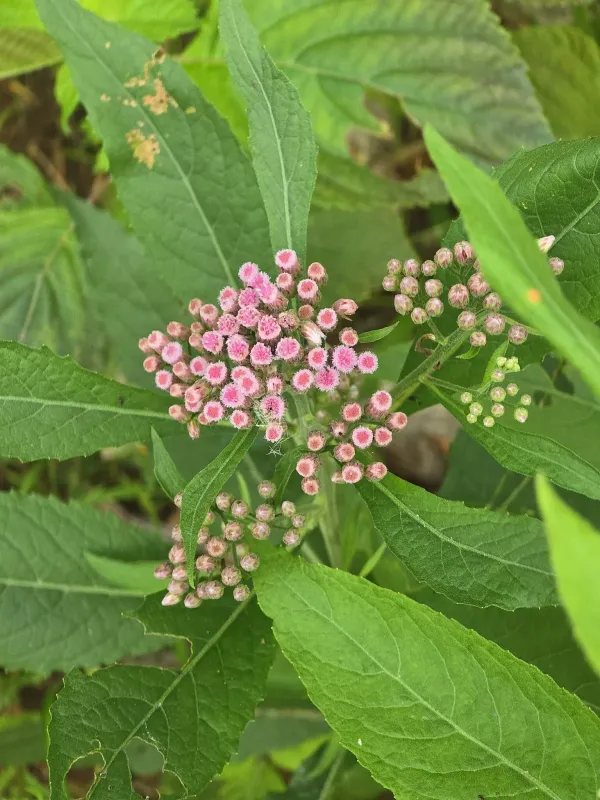
Camphorweed (Pluchea camphorata) is an annual plant belonging to the Asteraceae family. It is easily recognized by the strong camphor-like scent it emits when the foliage is bruised or crushed.
The plant typically grows between 30 and 100 cm tall, featuring an erect stem that branches significantly towards the top and is covered in glandular pubescence.
The leaves are alternate and lanceolate in shape, with distinct serrated margins. Lower leaves are petiolate, while the upper ones are sessile, gradually becoming smaller near the inflorescence.
Its flowers are arranged in small, dense heads that form terminal corymbs or panicles. The flowers themselves are tubular and typically exhibit shades of light purple or lavender.
Reproduction is entirely via seeds. Each seed is equipped with a pappus, which facilitates wind dispersal, allowing the plant to colonize large areas effectively over a single growing season.
Where it grows
Native to parts of the Americas, Camphorweed thrives in moist to wet environments. It is frequently found in wetlands, swamps, marshes, and along the banks of water bodies.
In agricultural settings, it is a common pest in irrigated crops, especially rice fields, and in poorly drained sections of fields where water accumulates after rain.
The weed often spreads along drainage ditches, canals, and road edges, which serve as corridors for migration into cultivated land through water movement or machinery contamination.
It prefers heavy, moisture-retentive soils. The presence of significant patches of this weed is often an indicator of inadequate field drainage or chronic over-irrigation in those spots.
It is capable of establishing itself in disturbed sites, making it a persistent colonizer of fallow fields and edges of agricultural operations that lack consistent vegetation management.
Harm it causes
Camphorweed competes aggressively with crops for essential resources including nitrogen, water, and sunlight, which can lead to a significant reduction in biomass of the primary crop.
The plant's height and rapid growth rate allow it to shade out smaller crops, creating a microclimate that can promote fungal diseases within the crop canopy due to restricted airflow.
It poses a threat to harvesting efficiency by physically obstructing mechanical equipment and increasing the moisture content of the harvested product, which can lead to storage issues.
The weed acts as a host for various insects and pathogens that can eventually jump to crops, thereby increasing the overall requirement for pesticide applications throughout the season.
Left unmanaged, its high seed production potential leads to a buildup of a persistent soil seed bank, making the land increasingly difficult and expensive to farm in subsequent years.
How to control
Effective management begins with improving field drainage. By addressing water accumulation, farmers can drastically reduce the suitability of the soil for Camphorweed germination.
Mechanical control, such as deep tillage, is effective in burying the seeds deep enough to prevent them from successfully emerging, especially if performed before seed set.
Chemical control involving broadleaf-selective herbicides is a standard approach. Treatment should be timed early in the growth stage to ensure maximum efficacy before the plant becomes woody.
Sanitation of field margins and surrounding drainage areas is crucial to prevent the reintroduction of seeds into the main production area, as wind and water are primary dispersal vectors.
- Regular monitoring and spot-spraying in early growth stages.
- Using competitive cover crops to suppress weed emergence.
- Cleaning agricultural equipment to prevent seed transport between fields.
- Maintaining well-structured crop rotation plans to disrupt the weed's life cycle.
Taxonomy
- Latin name
- Pluchea camphorata
- Family
- Сложноцветные (астровые)
- EPPO code
- PLUCA