
Common butterwort
Pinguicula vulgaris
Description
How to tell it apart
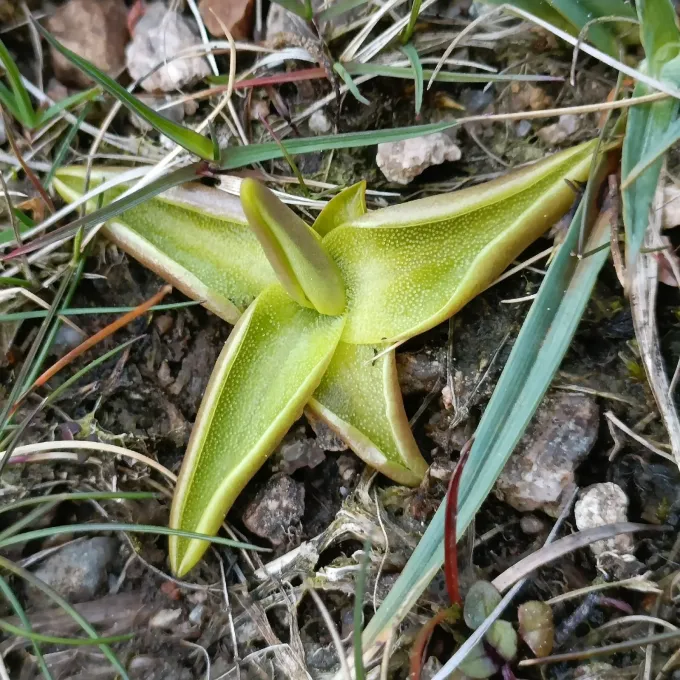
Common butterwort (Latin: Pinguicula vulgaris) belongs to the Lentibulariaceae family. It is a perennial carnivorous herbaceous plant featuring a distinctive rosette of pale-green, fleshy, glandular leaves.
During the flowering season, the plant produces single scapes, topped with beautiful violet flowers with a long spur. The leaves are covered in a sticky secretion that serves as a trap for small insects, providing the plant with supplemental nutrition.
The root system of the butterwort is poorly developed, consisting of a short rhizome with few thin roots. The plant is low-growing, rarely exceeding 15 centimeters in height, which makes it inconspicuous within dense vegetation.
To identify this species, it is essential to observe the specific shiny leaf surface, which feels "greasy" to the touch due to numerous glands. Unlike many other weeds, butterwort prefers locations with excessive moisture and nutrient-poor soils.
Butterwort reproduces both via seeds and vegetatively by forming daughter buds at the base of the rosette. The seeds are very small and are easily dispersed by wind and water, facilitating the rapid colonization of suitable ecological niches.
Where it grows
Common butterwort is primarily found in areas with consistently high soil moisture. Its natural habitats include wet meadows, pond shores, boggy areas, and slopes with groundwater seepage.
In agroecosystems, this plant may appear in waterlogged fields with poor drainage or in low-lying pasture zones. While it rarely becomes a mass-scale weed, it is capable of colonizing wet patches with high population density.
The plant prefers acidic or neutral soils rich in humus but can survive on poor substrates where other weeds fail to compete due to nutrient deficiencies. It thrives where competition from larger, more aggressive plants is limited.
In agriculture, butterwort is not a dominant pest in traditional cereal crops but can pose problems in wet forage lands. Its presence is a strong indicator that land reclamation or drainage improvement is required.
It is frequently found in river floodplains, where periodic flooding prevents the growth of more aggressive crop species, giving the specialized butterwort a competitive advantage.
Harm it causes
The main harm caused by common butterwort is its competition with forage grasses in waterlogged pastures. By occupying space, it reduces the overall productivity of grazing lands and the nutritional value of the sward.
Although the plant is carnivorous, it does not pose a direct threat to agricultural crops in terms of invasive spread. Its harm is localized and primarily serves as an indicator of unfavorable field conditions.
The presence of butterwort in a field may signal water stagnation, which can provoke fungal diseases in valuable agricultural crops. Thus, it acts more as an indicator of agronomic management errors.
In rare cases, excessive growth of butterwort leads to the displacement of beneficial meadow grasses. This is particularly relevant for intensively managed pastures that require the maintenance of a specific botanical composition.
The economic impact of butterwort is often underestimated because it is not toxic to livestock, yet it occupies valuable land that could be utilized by more productive forage species.
How to control
The most effective method for controlling butterwort is high-quality land reclamation. Draining wet lowlands and improving the field's drainage system fundamentally alter the habitat, making it unsuitable for this species.
Agronomic control involves regular mowing of the sward and the application of lime fertilizers if the soil is highly acidic. This promotes the growth of forage crops, which naturally outcompete the butterwort.
Chemical control is applied very rarely and only in cases of high population density over large areas. The use of broad-spectrum herbicides must be well-justified, as butterwort usually does not reach a critical threshold of economic damage.
Preventative measures include avoiding soil compaction and water stagnation in fields. Maintaining an optimal soil water-air balance is the key to getting rid of such moisture-loving species.
It is recommended to implement appropriate crop rotations that include species capable of actively suppressing weed vegetation during the early stages of development, thereby minimizing the probability of butterwort colonization.
Taxonomy
- Latin name
- Pinguicula vulgaris
- Family
- Пузырчатковые
- EPPO code
- PNUVU