
King devil
Pilosella piloselloides
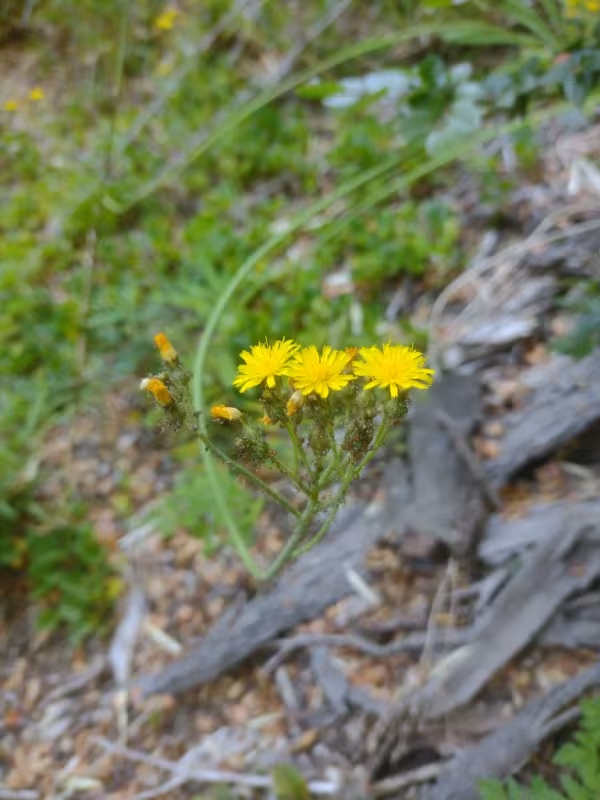
Description
How to tell it apart
King devil (Pilosella piloselloides), also known as tall hawkweed, is a perennial herbaceous weed belonging to the Asteraceae family. It is a creeping, stolon-forming plant that spreads both vegetatively and through wind-dispersed seeds.
The plant features a basal rosette of lanceolate or spatulate leaves. A key diagnostic characteristic is the presence of dense, often greyish hairs on the leaf surfaces and stems.
Flower stalks reach heights of 30–60 cm and produce yellow, dandelion-like flower heads. The involucral bracts beneath the flower heads are covered with glandular and simple hairs.
The root system consists of a fibrous structure with horizontal rhizomes (stolons) that allow the plant to colonize surrounding soil patches efficiently. This structure makes the plant remarkably resilient.
As a perennial species, it possesses a high level of phenotypic plasticity, allowing it to thrive in diverse and challenging environmental conditions across agricultural landscapes.
Where it grows
King devil thrives in nutrient-poor, dry, and sandy or gravelly soils. It is commonly found in pastures, meadows, roadsides, and open fields where competition from taller vegetation is limited.
In agriculture, it is a significant nuisance in established perennial grasslands and cereal crops. It often invades disturbed areas or pastures where overgrazing has thinned the vegetation cover.
The plant is known for its tolerance to acidic soil conditions, often dominating areas where soil fertility is low. It prefers open, sunny locations with minimal shading from other plants.
Seed dispersal is highly effective due to the pappus (parachute-like bristles) on the achenes, allowing the wind to carry seeds over vast distances, facilitating rapid colonization of new fields.
It is frequently found in clusters that expand outward, eventually forming dense mats that exclude desirable grasses and other plant species.
Harm it causes
The primary damage caused by King devil is its intense competition for water and soil nutrients. Due to its deep root system and stolons, it effectively drains resources, weakening nearby crop plants.
King devil exhibits allelopathic properties, meaning its root exudates can chemically inhibit the germination and growth of neighboring beneficial crops, leading to lower yields.
In forage production, the presence of King devil reduces the nutritional value of pasture. Livestock typically avoid grazing it due to its tough, hairy texture, which lowers the overall productivity of the field.
Economic losses are compounded by the difficulty of eradicating established patches, which often necessitates costly chemical treatments or complete field renovation.
Furthermore, it acts as a secondary host for various plant pathogens and pests, potentially serving as a reservoir that threatens adjacent healthy crops during the growing season.
How to control
Cultural control strategies include deep plowing to disrupt the stolon network and deplete the plant's energy reserves. Ensuring competitive crop density is vital, as King devil struggles to establish in dense, healthy stands.
Soil management practices, such as liming to correct acidity and strategic fertilization, help shift the ecological balance in favor of crop plants, allowing them to outcompete the weed.
Chemical control usually requires systemic herbicides (e.g., 2,4-D or dicamba). Applications are most effective during the early rosette stage before the plant begins to bolt and flower.
Due to the dense hairiness of the leaves, the use of surfactants is highly recommended to improve herbicide penetration. Repeated applications are often necessary to exhaust the root system completely.
- Monitor fields frequently for early-stage infestations.
- Maintain robust, competitive crop cover.
- Use herbicides during the active growth phase of the rosette.
- Avoid overgrazing to prevent ground disturbance.
Taxonomy
- Latin name
- Pilosella piloselloides
- Family
- Сложноцветные (астровые)
- EPPO code
- HIEPO