
Peleter's hawkweed
Pilosella peleteriana
Description
How to tell it apart
Peleter's hawkweed (Pilosella peleteriana) belongs to the Asteraceae family. It is a perennial herbaceous plant with a short rhizome that forms basal rosettes of leaves.
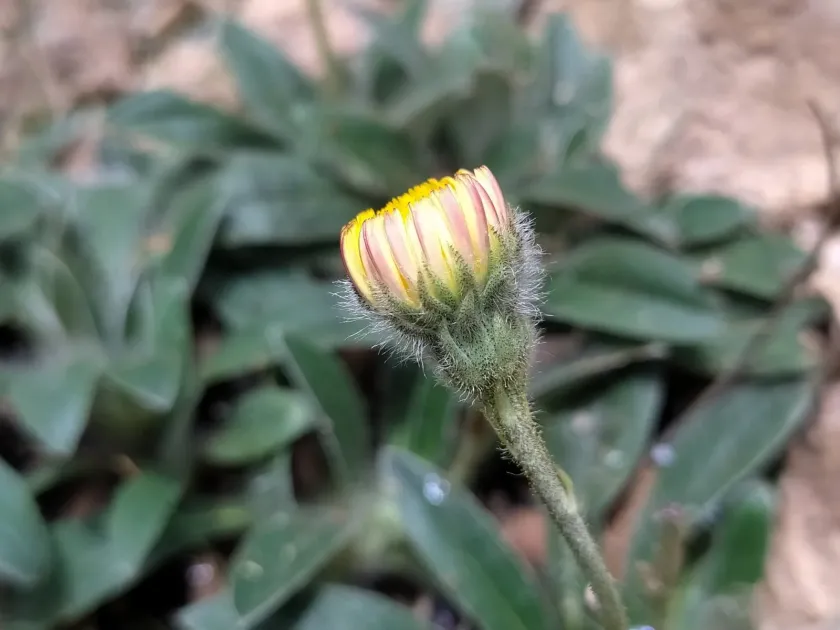
Externally, the plant is characterized by dense pubescence consisting of simple and glandular hairs, which gives it a grayish tint. The leaves are entire, oblong-lanceolate in shape.
The flowering stem usually bears a single large head with bright yellow ray florets. Unlike some related species, Peleter's hawkweed does not form long above-ground stolons, propagating mainly by seeds and division of the clump.
The seeds (achenes) have a pappus of bristles, which facilitates their effective dispersal by wind over considerable distances. The flowering period occurs in late spring and early summer.
A distinctive feature of the species is its high ecological plasticity and ability to survive on poor, sandy, or stony soils where competition with other species is minimal.
Where it grows
This species prefers open, well-lit areas with moderate moisture. It is most often found on dry meadows, pastures, sand dunes, and open slopes.
In agroecosystems, Peleter's hawkweed can infest perennial grass fields, forage lands, and fallow fields. It is frequently found on field edges, boundaries, and along rural roads, from where it gradually spreads to cultivated lands.
The plant successfully occupies areas with disturbed turf, quickly colonizing open niches. Due to its unpretentiousness, it becomes a serious problem in low-management pastures.
It is found in almost all regions of the temperate climatic zone, preferring acidic or neutral soils. In heavily fertilized fields, it is outcompeted by more aggressive weed species.
Given its biological characteristics, the weed is most dangerous in areas with sparse vegetation or in thin stands of cultivated crops.
Harm it causes
The harmfulness of Peleter's hawkweed lies in its ability to actively compete with crops for space and nutrients, especially in the early stages of development.
The weed inhibits the growth of valuable forage grasses on pastures, reducing their productivity and nutritional value. Dense leaf rosettes block sunlight from reaching the soil and seedlings.
When it spreads extensively, the plant forms patches that are difficult to eradicate, which degrades the overall phytosanitary condition of the field. This leads to reduced crop quality and complicates harvesting processes.
The weed can also act as a reservoir for a number of pathogens that affect agricultural crops. Constant presence of the species in the field depletes moisture reserves in the topsoil.
Economic damage increases in forage lands where this hawkweed outcompetes legumes and grasses, worsening the botanical composition of hayfields.
How to control
Agronomic control measures include systematic pruning of the root system during deep plowing or cultivation. It is important to prevent flowering and seed maturation on adjacent territories.
On pastures, it is recommended to improve the stand by overseeding competitive perennial grasses and applying fertilizers, which promotes natural displacement of the weed.
An effective method is the use of systemic herbicides, especially those based on 2,4-D, MCPA, or glyphosate (on non-crop areas). Treatment is best performed in the rosette stage before intensive flowering begins.
The use of crop rotation including row crops allows for effective suppression of the weed through frequent inter-row cultivations. In mechanical methods, it is important to avoid fragmentation of rhizomes, as this may lead to vegetative propagation.
- Regular mowing before flowering.
- Deep autumn plowing.
- Application of broad-spectrum herbicides.
- Improving soil fertility to increase crop competitiveness.
- Ensuring purity of seed material.
Taxonomy
- Latin name
- Pilosella peleteriana
- Family
- Сложноцветные (астровые)
- EPPO code
- QJLPE