
King devil
Pilosella floribunda
Description
How to tell it apart
King devil (Pilosella floribunda), formerly Hieracium floribundum, is a persistent perennial weed belonging to the Asteraceae family.
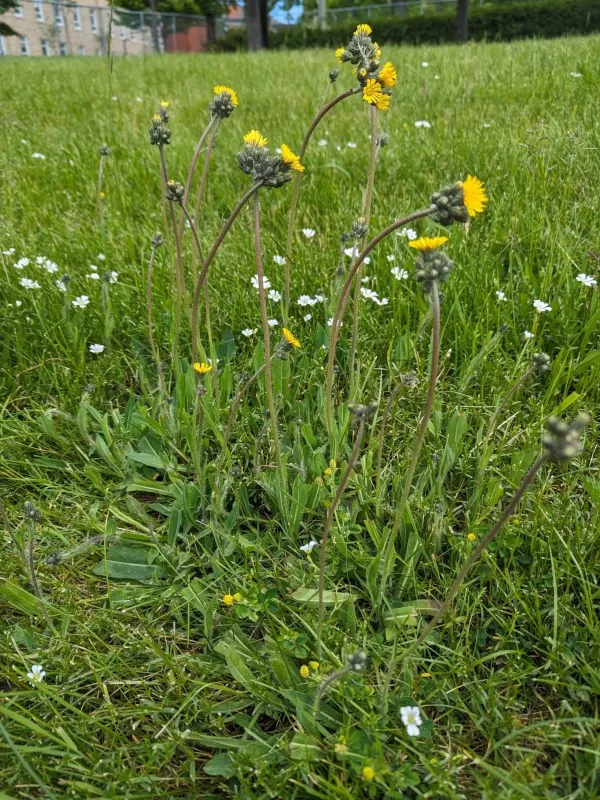
It is characterized by a basal rosette of leaves and a flowering stem covered with distinctive glandular hairs, which give the plant a fuzzy appearance.
The inflorescence consists of numerous small, bright yellow flower heads arranged in a dense, flat-topped cyme at the apex of the stem.
The plant spreads efficiently through both seed production and aggressive vegetative growth using above-ground runners known as stolons.
The root system is fibrous and dense, allowing the plant to anchor itself firmly in various soil types while expanding its territory via stolons.
Where it grows
King devil is highly adaptable and thrives in sunny, open environments, often colonizing disturbed sites and poor, acidic soils.
Common habitats include pastures, meadows, roadsides, and cleared forest areas, from where it easily encroaches upon cultivated lands.
In agricultural settings, it is a significant nuisance in perennial forage crops, lawns, and neglected fields where it competes for space.
It is capable of establishing itself in various moisture regimes, showing a preference for well-drained soils but tolerating a wide range of conditions.
The plant's ability to form thick, exclusive mats makes it a problematic invasive species in both agricultural and natural grasslands.
Harm it causes
The primary agricultural impact of King devil is its intense competition for nutrients, light, and water, which stunts the growth of desired crops.
It exerts an allelopathic influence on the surrounding vegetation, chemically suppressing the growth of competitive plants within its vicinity.
The presence of dense colonies significantly reduces the productivity and quality of hay and pasture lands, making the forage less palatable to livestock.
Infestations complicate field operations and can result in reduced yields, as the weed quickly occupies gaps created during cultivation.
Once established, the extensive network of stolons makes the plant difficult to remove manually, requiring long-term management strategies.
How to control
Successful management of King devil requires a combination of mechanical, chemical, and cultural approaches to suppress its growth and spread.
- Implement mechanical control by deep plowing and regular cultivation to disrupt the stolon network and deplete root reserves.
- Use selective herbicides, particularly those targeting broad-leaved weeds, applied during the rosette stage before flowering.
- Promote crop competition by maintaining dense stands of desirable forage or cover crops to shade out the weed seedlings.
- Mow or graze affected areas frequently to prevent seed set, though this does not eradicate the established vegetative parts.
- Monitor field edges and buffers to prevent the spread of stolons and seeds into the main production areas.
Taxonomy
- Latin name
- Pilosella floribunda
- Family
- Сложноцветные (астровые)
- EPPO code
- HIEFL