
Creeping hawkweed
Pilosella flagellaris
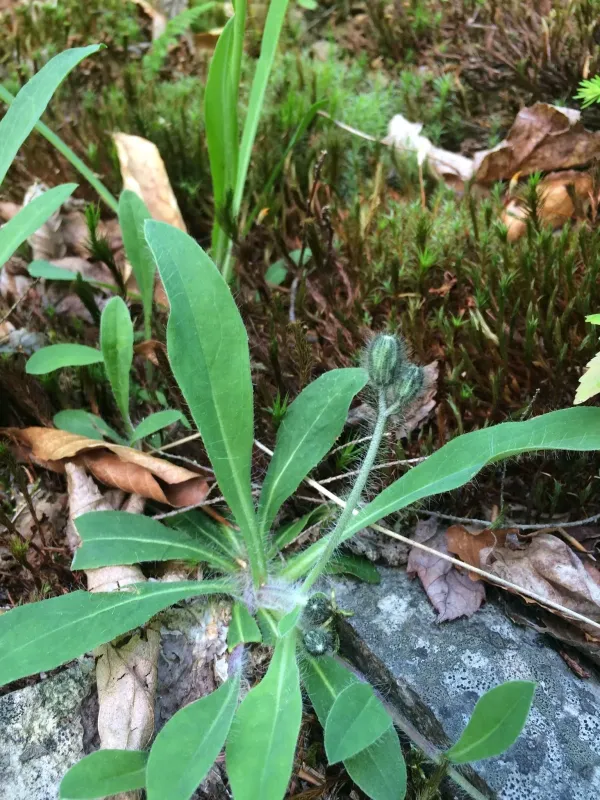
Description
How to tell it apart
Creeping hawkweed (Pilosella flagellaris) is a perennial herbaceous plant belonging to the Asteraceae family, well-known for its aggressive vegetative reproduction.
The plant grows in basal rosettes and produces long, above-ground stolons (runners) that creep along the soil surface, rooting at nodes to form new, independent daughter rosettes.
Leaves are oblong-lanceolate and covered with fine, dense hairs, which help the plant adapt to dry environments and reduce water loss through transpiration.
The yellow, daisy-like flower heads are borne on slender, hairy stalks that emerge from the center of the rosette, typically blooming during late spring and summer.
Its complex root system consists of both a primary taproot and adventitious roots formed by the creeping stolons, making it a persistent and difficult-to-control perennial.
Where it grows
This species favors dry, nutrient-poor, and light-textured soils, often thriving in pastures, meadows, waste grounds, and along roadsides.
It frequently colonizes areas with thin or disturbed vegetation cover, where the lack of competition from established grasses allows the weed to spread rapidly.
In agricultural settings, it can become a problematic weed in permanent grasslands and occasionally in low-maintenance grain fields or fallow land.
The weed exhibits high ecological plasticity, allowing it to survive in varied moisture conditions while outcompeting local flora in open landscapes.
Dispersal is primarily achieved through seed production, which can be carried by wind, as well as by the fragmentation of stolons moved during mechanical soil cultivation.
Harm it causes
Creeping hawkweed causes significant harm by competing with crops and forage plants for essential soil moisture and mineral nutrients throughout the growing season.
The dense, creeping mat of rosettes and stolons effectively smothers desirable plant species, significantly reducing the botanical diversity and yield of pastures.
Because the plant is unpalatable to most livestock due to its hairy texture, it reduces the overall quality and nutritional value of grazing land.
When present in harvestable crops, the succulent green parts of the plant can increase the moisture content of the harvested grain, potentially leading to storage issues.
Economic losses arise not only from reduced forage production but also from the high costs associated with repeated chemical or mechanical control measures required to suppress its growth.
How to control
Effective management includes deep plowing, which helps to bury the root system and disrupt the connection of the stolons, significantly weakening the plant's regeneration capability.
Maintaining a dense and vigorous sward in pastures is the most effective biological control, as it prevents the weed from establishing new rosettes in the open soil.
Chemical control with systemic herbicides, such as those containing 2,4-D, dicamba, or sulfonylureas, can be effective if applied during the active growth phase.
Regular mowing of infested areas, while not curative on its own, helps to deplete the plant's energy reserves and limit its ability to produce seeds and new runners.
Integrating mechanical control methods with appropriate fertilizer applications ensures that desired crops gain a competitive advantage over the hawkweed infestations.
Taxonomy
- Latin name
- Pilosella flagellaris
- Family
- Сложноцветные (астровые)
- EPPO code
- QJLFG