
Meadow hawkweed
Pilosella caespitosa
Description
How to tell it apart
Meadow hawkweed (Pilosella caespitosa) is a perennial herb belonging to the Asteraceae family. It is characterized by short rhizomes and long, leafy stolons that enable rapid vegetative spread.
The plant grows as a basal rosette of lance-shaped leaves, which are densely covered with stiff hairs. The upper leaf surface is typically dark green, while the underside appears lighter.
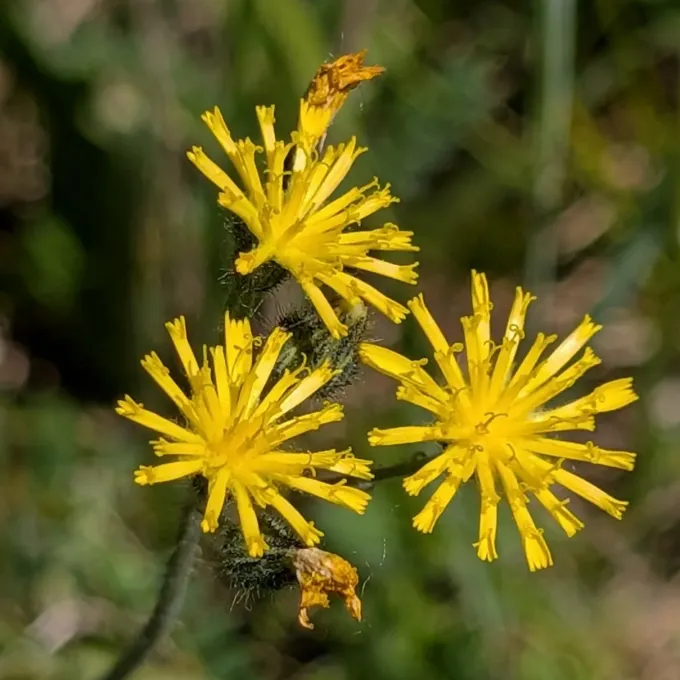
Flowering stems are upright, nearly leafless, and reach heights of up to 60 cm. The flowers form dense, yellow, flat-topped clusters that are highly visible during the peak season.
Flowering occurs throughout early summer, followed by the production of numerous wind-dispersed seeds. Each seed is equipped with a small tuft for long-distance travel.
In the field, it is easily identified by its distinctive yellow blooms, hairy foliage, and the ability to form thick, persistent mats that outcompete native vegetation.
Where it grows
This weed thrives in acidic, nutrient-poor soils with good aeration. It is commonly found in pastures, meadows, woodland edges, and neglected areas.
In agriculture, it poses a threat to forage productivity, as it invades grassland and displaces high-quality grasses and legumes favored by livestock.
It prefers low-fertility sites where cultural practices have been neglected, allowing the weed to establish itself in sparse crop stands or unmanaged pastures.
The plant is highly adaptable and can quickly colonize disturbed ground, often becoming a dominant species in areas with low competition pressure.
Meadow hawkweed frequently expands through patchy growth, eventually merging into solid colonies that require intensive management to reverse the process.
Harm it causes
The primary impact of meadow hawkweed is intense competition for water and soil nutrients, which directly suppresses the growth and yield of cultivated crops.
In pastures, it significantly reduces forage quality, as the coarse, hairy texture of the leaves makes the plant unpalatable for cattle and sheep.
Dense mats created by the weed hinder mechanical field operations and make it difficult for new seedlings of desirable species to establish effectively.
The species exhibits allelopathic effects, releasing chemicals into the soil that can inhibit the germination and growth of competing plants nearby.
Due to its high seed production and aggressive vegetative growth, meadow hawkweed can rapidly spread, leading to significant economic losses in infested fields.
How to control
Cultural control measures, such as deep tillage, can help bury the root system and interrupt the development of stolons, thereby reducing the population density.
Improving soil fertility is a critical strategy, as meadow hawkweed is poorly adapted to high-nutrient environments and struggles to compete with vigorous crops under such conditions.
Mowing and rotational grazing can help manage the weed by reducing seed set, though these methods alone are rarely sufficient to eradicate established infestations.
Chemical control involving selective post-emergence herbicides, particularly those targeting broadleaf perennials, is often necessary for effective eradication.
Applications should be timed to coincide with the rosette stage of development to maximize systemic herbicide translocation into the roots and ensure long-term control.
Taxonomy
- Latin name
- Pilosella caespitosa
- Family
- Сложноцветные (астровые)
- EPPO code
- HIECA