
Orange hawkweed
Pilosella aurantiaca
Description
How to tell it apart
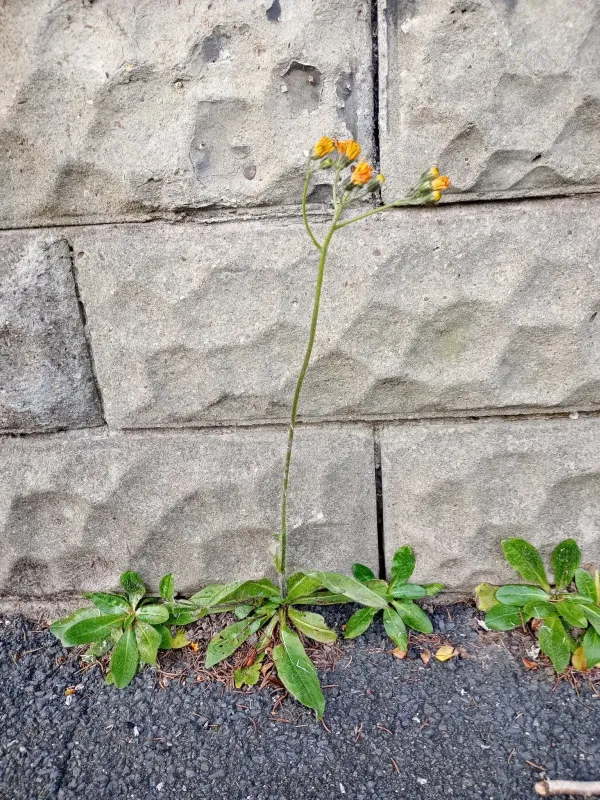
Orange hawkweed (Pilosella aurantiaca) is a perennial herbaceous plant belonging to the Asteraceae family. It is easily recognized by its vibrant orange-red flower heads clustered at the tops of hairy stems.
The plant grows to a height of 20–40 cm, with stems and leaves covered in distinct dark, glandular hairs. Its leaves are primarily arranged in a basal rosette, providing a dense cover at the ground level.
A key characteristic of this plant is its ability to spread via stolons (runners), which can be both above and below the soil surface. This growth pattern allows the plant to form dense, solid mats.
Reproduction occurs both vegetatively and through wind-dispersed seeds. Each plant can produce thousands of seeds, which are equipped with small bristles that facilitate long-distance travel by wind.
This weed is highly adaptable, thriving in various environments, from disturbed roadsides to stable, permanent pastures, and is particularly prevalent in soils with low nutrient content.
Where it grows
Orange hawkweed prefers acidic, nutrient-poor soils. It is frequently found in meadows, pastures, forest clearings, and areas where the existing vegetation is sparse or under stress.
In agricultural settings, it becomes a significant invasive species in permanent pastures and hayfields. It easily outcompetes desirable forage grasses if the land is not managed with proper fertilization or rotational grazing.
It is also commonly observed in non-cropped areas such as ditches, roadside verges, and field margins. From these sites, it spreads into cultivated fields through agricultural equipment or natural means.
The plant is highly resilient to grazing and trampling by livestock, which often gives it a competitive advantage over more sensitive, high-quality forage plants in heavily used pastures.
It thrives in cooler climates and is particularly problematic in mountainous or northern agricultural regions where competitive pressure from other dense-growing plants is naturally lower.
Harm it causes
The primary damage caused by orange hawkweed is the formation of dense monocultures. By creating a thick ground cover, the plant effectively blocks sunlight, preventing the germination of other beneficial plant species.
It exhibits allelopathic properties, releasing chemical compounds into the soil that inhibit the growth and development of neighboring plants, reducing the overall biodiversity of the ecosystem.
In pastures, it is considered a low-value forage plant. Livestock generally avoid it, leading to a significant decrease in the grazing capacity of the land and a decline in livestock productivity.
The weed acts as a persistent seed bank, with seeds potentially remaining viable in the soil for several years, making eradication efforts challenging and requiring long-term monitoring.
By crowding out quality forage, the weed increases the cost of land maintenance, as farmers are forced to reseed or implement intensive chemical programs to reclaim the productivity of their fields.
How to control
Controlling orange hawkweed requires a multi-faceted approach. Cultivation techniques, such as deep plowing, are effective for destroying the stolon networks in areas where regular cropping is practiced.
In pastures, maintaining a healthy, dense forage stand is the best defense. Regular fertilization and liming to adjust pH can make the environment less favorable for the hawkweed and more suitable for vigorous grasses.
Manual removal is only feasible for very small, isolated patches. For larger infestations, chemical control using herbicides containing 2,4-D, dicamba, or clopyralid is the standard industry practice.
Applications are most effective when the plant is in the rosette stage, prior to the development of flowering stalks, ensuring that the chemicals are effectively translocated to the root system.
- Regular mowing to prevent seed set.
- Soil nutrient management to boost competitive grasses.
- Targeted herbicide application in the early season.
- Preventing the transport of plant fragments via machinery.
Taxonomy
- Latin name
- Pilosella aurantiaca
- Family
- Сложноцветные (астровые)
- EPPO code
- HIEAU