
Stinkweed
Oncosiphon grandiflorum
Description
How to tell it apart
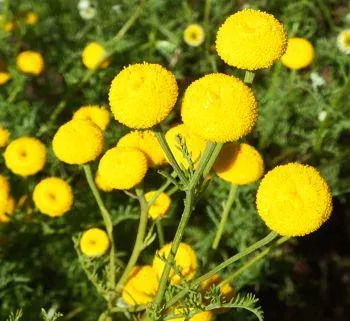
Oncosiphon grandiflorum, commonly known as Stinkweed, is a member of the Asteraceae family. It is an annual plant characterized by its highly dissected, feathery foliage that resembles various species of chamomile or wormwood.
The plant typically grows as a bushy herb with a height ranging from 20 to 60 cm. It features erect, branched stems that provide a dense habit, especially when growing in favorable conditions.
The flowers are arranged in small yellow capitula (heads), which are clustered into compound corymbs. These heads lack showy ray florets, giving them a distinct, non-traditional appearance compared to other meadow daisies.
Stinkweed possesses a strong taproot, which allows it to secure nutrients and moisture effectively from the soil, enabling it to outcompete crops in various environments.
The seeds are minute and lightweight, often equipped with aerodynamic shapes that facilitate dispersal by wind, irrigation water, and the movement of agricultural machinery across fields.
Where it grows
This weed is native to South Africa but has become a significant agricultural concern in various regions globally, including parts of Australia, due to its invasive potential in disturbed habitats.
Stinkweed thrives in open, sunny locations and is commonly found on degraded pastures, along roadsides, and in fallow fields where competition from perennial grasses is low.
In cultivated settings, it primarily infests grain crops and vegetable fields, demonstrating a high degree of adaptability to both sandy and clay-based soil types.
The plant is highly resilient to dry spells, which allows it to colonize regions where agricultural crops struggle with moisture availability, thereby becoming a primary weed concern.
Agricultural equipment is a primary vector for the spread of this plant, as seeds can easily lodge in soil clods or treads, transporting them to clean plots.
Harm it causes
The primary damage caused by Oncosiphon grandiflorum is intense nutrient and water competition, which is particularly detrimental to crop seedlings during their early growth stages.
Its rapid canopy development shades out crops, which restricts photosynthesis and leads to stunted crop growth and reduced biomass production in the field.
Stinkweed can significantly diminish crop yield potential by taking up valuable soil moisture and space that the primary crop requires for its reproductive success.
Furthermore, its presence during harvest can lead to the contamination of harvested grain, necessitating extra cleaning and processing steps, which significantly increases farm operational costs.
- Depletion of essential soil moisture and nutrients.
- Increased shading effect on crop sprouts.
- Reduction in total harvestable grain yield.
- Added costs for grain cleaning and quality control.
How to control
Mechanical control involves deep primary tillage, such as moldboard plowing, which effectively buries the seeds at depths where they fail to germinate or survive long-term.
Implementing a diverse crop rotation is a vital preventive strategy, as it disrupts the growth cycle of the weed and creates a competitive environment that discourages its dominance.
Chemical control is achieved through the use of post-emergence selective herbicides applied during the rosette stage, when the weed is most vulnerable to systemic active ingredients.
Sanitation of field margins and surrounding areas is crucial to prevent the migration of seeds into the fields before they reach the flowering phase, thus curbing population growth.
Regular field scouting is highly recommended to identify early-stage infestations, allowing for spot-treatment or localized removal before the weeds reach the seeding stage.
Taxonomy
- Latin name
- Oncosiphon grandiflorum
- Family
- Сложноцветные (астровые)
- EPPO code
- PENGR