
Fragrant false garlic
Nothoscordum gracile
Description
How to tell it apart
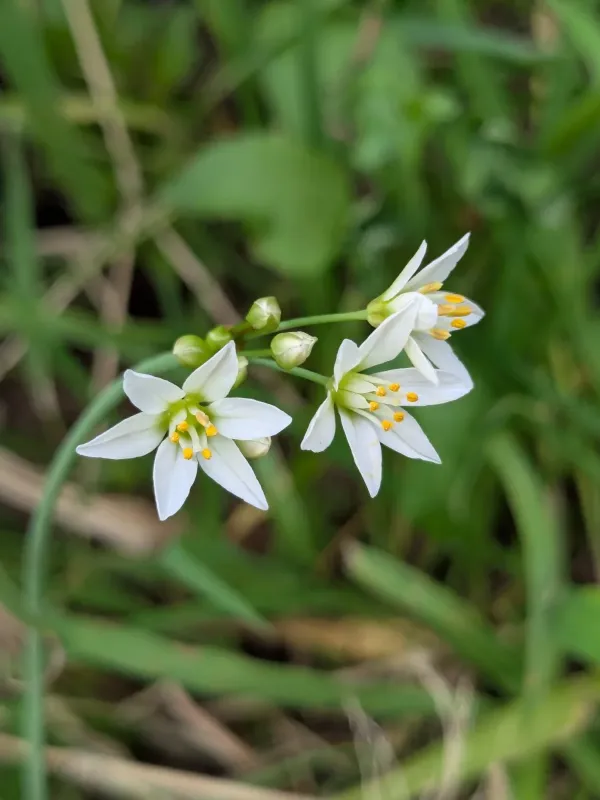
Fragrant false garlic (Nothoscordum gracile) belongs to the Amaryllidaceae family. It is a perennial bulbous plant that visually resembles onions or garlic but lacks a strong alliaceous odor when leaves are crushed.
The leaves are narrow, linear, and arise from the base, forming a dense clump. The plant produces leafless flowering stalks topped with umbel-like inflorescences featuring small white or yellowish flowers.
This weed reproduces actively through vegetative means, producing numerous small daughter bulbs in the soil surrounding the parent plant.
Its root system is fibrous, originating from the base of the bulb. During mechanical cultivation, these bulbs are easily detached and spread across the field by machinery.
Seeds are small, black, and possess high viability, allowing them to remain in the soil bank for several years until favorable conditions trigger germination.
Where it grows
This species prefers well-drained, fertile soils and is frequently found in temperate and subtropical regions. It poses a significant threat to vegetable crops and ornamental nurseries.
It infests row crops, cereals, orchards, vineyards, and lawns, where irrigation provides consistent moisture necessary for its rapid growth and multiplication.
The plant exhibits high ecological plasticity, adapting successfully to both full sunlight exposure and partially shaded areas in agricultural environments.
In agroecosystems, the weed rapidly claims vacant space, competing with crops for essential nutrients and moisture throughout the growing season.
Spread often occurs through contaminated soil, agricultural equipment, or the trade of ornamental bulbous plant stock from infested areas.
Harm it causes
The primary damage arises from its high competitive capacity during the early stages of crop development, which can significantly reduce final harvest yields.
Due to the reserves stored in its bulbs, Nothoscordum possesses the ability to recover rapidly after partial mechanical weeding or mowing of the foliage.
The weed releases specific metabolites into the soil that can exhibit allelopathic effects, inhibiting the growth and development of neighboring crop plants.
When infestation levels are high, the weed forms a dense carpet that complicates standard agronomic operations and promotes moisture retention in the root zone.
Manual removal is notoriously difficult, as small bulbs are often left behind in the soil, leading to immediate re-emergence of the weed population.
How to control
Agronomic control practices include deep plowing with soil inversion, which buries the bulbs deep enough to significantly hinder their emergence to the surface.
An important technique is the systemic exhaustion of the bulbs through repeated mechanical hoeing or cultivation during the active growth phase before daughter bulb formation.
Chemical control requires the use of systemic herbicides capable of translocating into the bulbs to achieve complete mortality of the underground parts.
Application of non-selective herbicides, such as glyphosate-based products, is most effective when plants are in a state of nutrient translocation to the bulb, typically before flowering.
Implementing a proper crop rotation system using competitive cover crops is recommended to suppress weed development and prevent further expansion into clean fields.
Taxonomy
- Latin name
- Nothoscordum gracile
- Family
- Амариллисовые (сорные виды семейства)
- EPPO code
- NOTFR