
Schubert's onion
Allium schubertii
Description
How to tell it apart
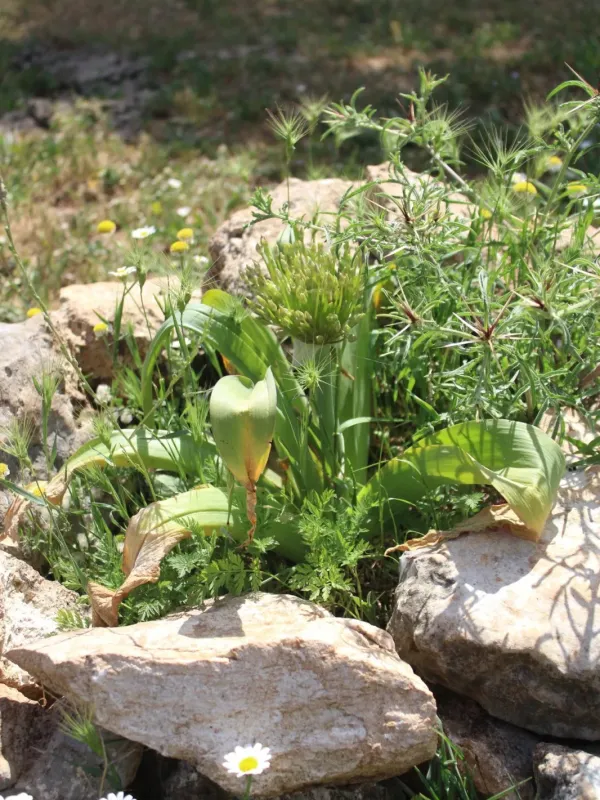
Schubert's onion is a perennial bulbous plant belonging to the Amaryllidaceae family. The plant features a shortened stem and a basal rosette of wide, lanceolate, glaucous-green leaves.
The main identifying feature is its inflorescence—a large, almost spherical umbel that can reach 20-30 cm in diameter. The flowers are star-shaped and tinted in pinkish-purple hues.
The plant reproduces both by seeds and vegetatively, forming daughter bulbs. After the seeds mature, the flower stalk often breaks off and is carried by the wind, acting as a tumbleweed.
The root system consists of a typical bulb, which serves as a nutrient storage organ. This allows the weed to survive unfavorable arid periods and quickly resume growth.
To identify the species, it is important to note the uneven length of the pedicels within a single umbel, which gives the inflorescence its characteristic "exploding" or chaotic appearance.
Where it grows
In natural conditions, this species grows in the Middle East and Central Asia. It prefers open, sunny areas with rocky or clay soils.
In an agricultural context, Schubert's onion can be found in fields adjacent to dry steppe zones as well as on fallow land. It is adapted to climates with hot, dry summers.
Most often, this species can be spotted along field roads, on pastures, and in areas where minimal tillage is practiced. The plant does not tolerate excessive waterlogging.
In fields with regular deep plowing, Schubert's onion is found less frequently, but it is capable of persisting in uncultivated areas (field margins), from where it gradually spreads.
The presence of this plant may indicate a disruption in the agricultural cycle in specific areas or a low level of control over perennial creeping weeds.
Harm it causes
The primary harm caused by Schubert's onion lies in its competition with crops for space and nutrients, especially during the early stages of crop development.
Like other Allium species, this weed can serve as a reservoir for specific fungal diseases and pests (e.g., onion flies), which then spread to vegetable crops.
When spreading en masse on pastures, the plant can reduce the nutritional value of forage, as it has a specific taste and odor that deters livestock.
The presence of bulbs in the soil complicates mechanical cultivation, as they can clog tillage tools and resume vegetation after partial damage.
In industrial crop fields, the weed creates obstacles during harvesting, lowering the quality of the crop due to vegetative debris and its persistent odor.
How to control
An effective agrotechnical method of control is regular deep plowing, aimed at exhausting the bulbs and preventing them from maturing and reproducing.
It is important to mechanically remove bulbs from fields, especially before flowering, to prevent the further spread of seeds throughout the area.
Adherence to crop rotation, including crops that require intensive inter-row cultivation, helps to significantly limit the population of this weed species.
Chemical control is possible using broad-spectrum systemic herbicides during the plant's active growing season before the formation of the flower stalk begins.
It is recommended to use combinations of herbicides effective against perennial broad-leaved weeds, strictly following the regulations on dosage and crop development stages.
Taxonomy
- Latin name
- Allium schubertii
- Family
- Амариллисовые (сорные виды семейства)
- EPPO code
- ALLZB