
Nuttall's povertyweed
Monolepis nuttalliana
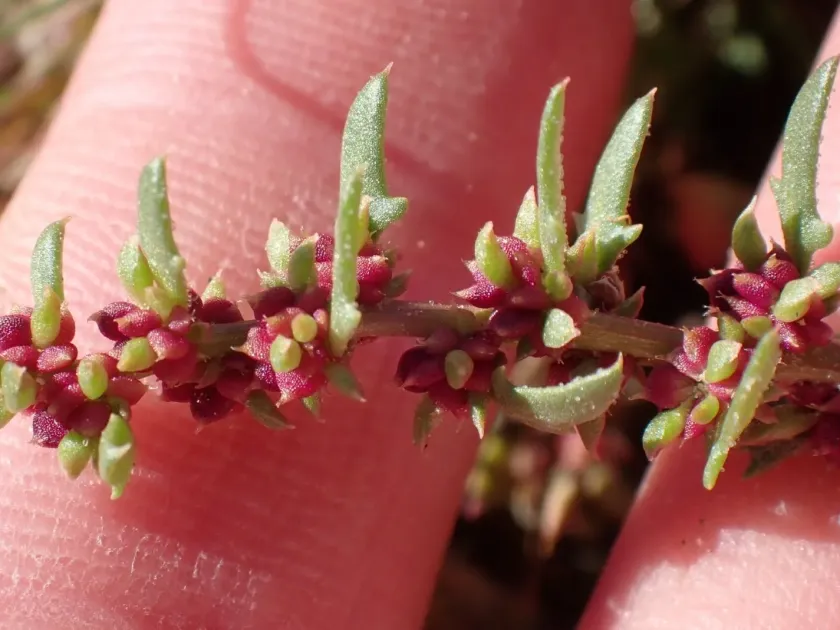
Description
How to tell it apart
Nuttall's povertyweed (lat. Monolepis nuttalliana) is an annual herbaceous plant belonging to the Amaranthaceae family. The plant typically features a prostrate or ascending stem that reaches heights of 5 to 30 centimeters.
The leaves are alternate, lanceolate or spatulate, and often have notched edges. Its overall appearance can sometimes be confused with common lambsquarters, although Monolepis is generally more fragile in its growth habit.
The flowers are very small, inconspicuous, and greenish, appearing in axillary clusters. The flowering period occurs during the spring and summer, allowing the plant to set viable seeds quite rapidly.
It possesses a taproot system that is moderately branched, enabling the plant to compete effectively for water and nutrients within the upper soil horizons.
The species is self-pollinating, which assists in its quick colonization of new areas. The seeds are small, dark, and easily dispersed by wind, water, and agricultural equipment.
Where it grows
Nuttall's povertyweed is a typical ruderal species most commonly found in disturbed areas, along roadsides, on waste grounds, and in fallow fields.
In agricultural settings, this weed poses a threat to row crops, small grains, and vegetable plantings, preferring open areas with full sun exposure.
The plant demonstrates high ecological plasticity, allowing it to thrive in diverse soil types, including saline or compacted substrates where crop plants often struggle.
It is frequently observed in gardens, where its hardy nature allows it to quickly occupy space after the harvest of early-season crops.
Due to its ability to complete its life cycle quickly, the weed can produce multiple generations in a single growing season if conditions are favorable.
Harm it causes
The primary harm caused by Nuttall's povertyweed is the intensive consumption of soil moisture and nutrients, which significantly suppresses the development of crop plants during early growth stages.
By infesting crop stands, the weed shades out seedlings, causing them to become spindly and reducing the overall productivity of the agroecosystem.
Nuttall's povertyweed can serve as a reservoir for various viral and fungal diseases, as well as an alternative host for certain agricultural insect pests.
The presence of this weed interferes with harvesting operations and can lower the quality of the harvested grain due to the contamination with weed seeds.
- Competition for vital soil moisture and nutrients.
- Shading effects on crop seedlings.
- Acting as a host for crop pathogens.
- Reduced harvest quality and marketability.
How to control
Agronomic control measures include timely mechanical soil cultivation, such as deep plowing and systematic harrowing, which destroy seedlings before they reach the flowering stage.
Implementing a proper crop rotation that prevents the build-up of weed seeds in the soil, alongside maintaining optimal crop density, is essential for long-term management.
Chemical control involves the use of selective herbicides labeled for broadleaf weed control, applied during the active growth phase prior to the budding stage.
Cleaning crop seeds thoroughly before planting is a critical step to prevent the introduction of the weed into clean fields via contaminated seed lots.
Maintaining cleanliness along field margins, roadsides, and adjacent areas helps limit the spread of seeds by wind and reduces the pressure on cultivated lands.
Taxonomy
- Latin name
- Monolepis nuttalliana
- Family
- Амарантовые
- EPPO code
- MOPNU