
Mikania cordifolia
Mikania cordifolia
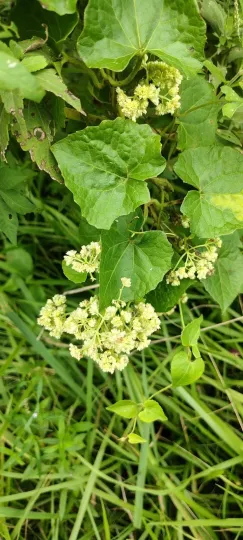
Description
How to tell it apart
Mikania cordifolia, commonly known as heart-leaf hempvine, is a perennial herbaceous plant or vine belonging to the Asteraceae family. It is distinguished by its heart-shaped leaves arranged oppositely along climbing stems.
The stems are capable of vigorous growth, allowing the plant to twine around supports and form dense, tangled mats across vegetation. The leaves often feature fine pubescence and may vary in texture based on the environment.
Small flowers are arranged in clusters, forming corymbs at the terminal ends of the stems. During the flowering stage, the plant can produce a large number of seeds, facilitating rapid spread.
The fruit is a small achene equipped with a pappus, which allows for wind dispersal across significant distances, complicating containment efforts in agricultural areas.
Below ground, the plant possesses a resilient and extensive root system, enabling it to survive in various soil types and regenerate quickly even after being cut back.
Where it grows
Mikania cordifolia is native to tropical and subtropical regions of the Americas. It thrives in humid conditions and is commonly found along forest edges, streams, and disturbed wetlands.
In agricultural settings, it is a problematic weed in plantations, particularly in crops like sugarcane, coffee, and cocoa, where it competes for space and sunlight.
The species is highly adaptable and frequently colonizes pastures, roadsides, and abandoned lands, effectively displacing native vegetation and creating dense, impenetrable monocultures.
Its ability to tolerate a range of soil nutrient levels allows it to persist in degraded soils, making it a persistent colonizer of fallow fields and edges of agricultural land.
Human activity, including the movement of contaminated equipment and soil, plays a significant role in spreading the plant's fragments and seeds into new, previously clean areas.
Harm it causes
The primary damage caused by Mikania cordifolia involves the physical suppression of crops. By twining around the stems, it creates a canopy that blocks sunlight, hindering the crop's development.
The competitive nature of the weed allows it to rapidly deplete soil moisture and essential nutrients, which directly impacts the vigor and overall yield of the cultivated plants.
The dense thickets created by the vine trap moisture, leading to an increase in humidity levels that favor the growth of fungal diseases, which can spread to the commercial crops nearby.
Mechanized farming operations are significantly hampered by the presence of this vine, as it interferes with cultivators, mowers, and harvesting machinery, leading to equipment downtime.
Increased production costs are a major consequence, as farmers must invest in additional chemical or labor-intensive control methods to protect the economic viability of their operations.
How to control
Mechanical control, such as deep plowing and regular cultivation, is essential to disrupt the root system and prevent the plant from re-establishing itself in the field.
Manual removal of the vines before they reach the flowering stage is a critical practice to stop the production of wind-dispersed seeds and minimize the seed bank in the soil.
Chemical control using systemic herbicides can be highly effective when applied to actively growing foliage, though care must be taken to minimize contact with desirable crops.
Implementing integrated pest management (IPM) strategies, including the use of cover crops, can help shade out the weed and reduce its ability to gain a foothold in agricultural land.
- Regular monitoring of field margins and surrounding areas for early detection.
- Cleaning equipment before moving from infested sites to pristine areas.
- Ensuring the use of high-quality, weed-free seed and nursery stock.
Taxonomy
- Latin name
- Mikania cordifolia
- Family
- Сложноцветные (астровые)
- EPPO code
- MIKCF