
Fringed Saltbush
Maireana ciliata
Description
How to tell it apart
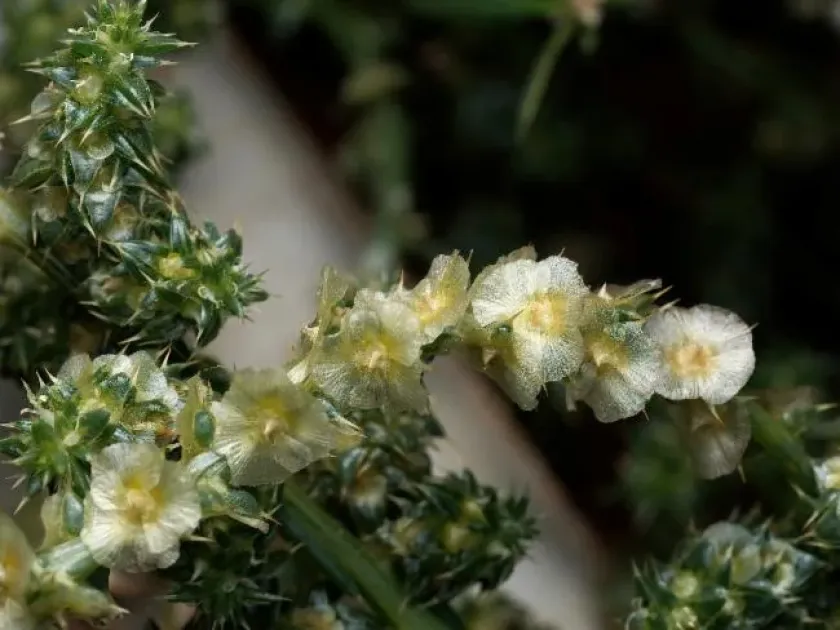
Maireana ciliata, commonly known as Fringed Saltbush, is a perennial plant belonging to the Amaranthaceae family. It is characterized by its small, fringed leaves covered in fine hairs, which give the plant its specific botanical name.
The plant typically grows as a small shrub or herbaceous sub-shrub with a robust, deep-reaching taproot system that allows it to survive in harsh, moisture-limited environments.
Its flowers are inconspicuous and tucked away in leaf axils, but the most distinctive feature appears during seed development, when the calyx expands into wing-like appendages for wind dispersal.
This species is highly adaptive, showing significant phenotypic plasticity in response to soil salinity and drought conditions, which often makes identification difficult in different regions.
The overall appearance is that of a compact, drought-tolerant bush that can thrive where more sensitive plant species fail to establish themselves.
Where it grows
The native range of Maireana ciliata is primarily located in the arid and semi-arid regions of Australia, where it is a common component of natural rangelands and desert vegetation.
In an agricultural context, it frequently invades disturbed lands such as roadsides, fence lines, and fallow fields, gradually encroaching upon active crop and pasture areas.
It favors sandy or well-drained soils and is particularly aggressive in areas where soil erosion or overgrazing has reduced the competitiveness of preferred plant species.
The plant's ability to tolerate high soil salt concentrations gives it an ecological advantage, allowing it to colonize saline-affected areas within farm boundaries.
As human activity changes landscape patterns, Fringed Saltbush has expanded its niche into areas near irrigation canals and poorly managed agricultural plots.
Harm it causes
The primary agricultural impact of Fringed Saltbush is its intense competition for water, which significantly stresses cereal crops in dry seasons and leads to reduced grain yields.
By forming dense, persistent clusters, the plant effectively suppresses crop growth by outcompeting young seedlings for nutrients and sunlight during critical stages of development.
The presence of this weed complicates mechanical harvesting processes, as its tough, woody stems can cause mechanical failure or accelerated wear on harvesting equipment.
Furthermore, the seeds of Fringed Saltbush are easily dispersed by wind, leading to widespread contamination of fields and necessitating expensive cleaning protocols for grain storage.
The species can also act as an alternative host for certain agricultural pests and diseases, providing them with a refuge during the off-season and allowing them to reinfect crops.
How to control
Effective management of Maireana ciliata requires a multidisciplinary approach, starting with deep tillage to physically disrupt the root system and prevent re-sprouting.
Crop rotation programs that include competitive cover crops are highly recommended to shade the soil and deprive the weed of the light necessary for its early development.
Chemical control involving systemic herbicides applied during the plant's peak growth phase is the most effective way to eliminate established infestations.
- Pre-planting application of broad-spectrum systemic herbicides.
- Targeted spot-spraying in field margins and near infrastructure.
- Strict management of livestock grazing to prevent the spread of seeds via manure.
Integrated weed management must also include monitoring field boundaries and cleaning equipment to prevent the introduction of seeds from adjacent, infested rangelands.
Taxonomy
- Latin name
- Maireana ciliata
- Family
- Амарантовые
- EPPO code
- KCHCI