
Lechea intermedia
Lechea intermedia
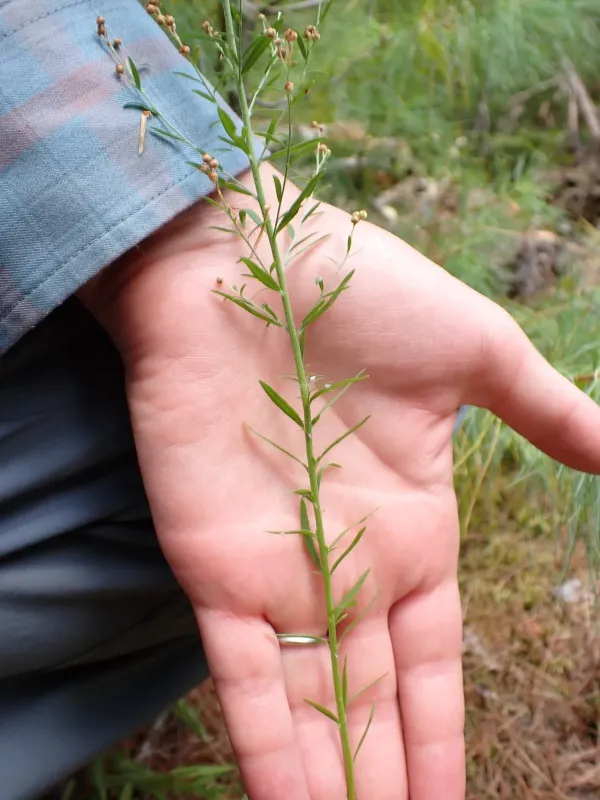
Description
How to tell it apart
Lechea intermedia, commonly known as the large-pod pinweed, is a perennial herbaceous plant belonging to the Cistaceae family, typically forming dense basal rosettes.
The stems are erect or ascending and often branched. The leaves are alternate, linear-lanceolate, and covered in fine appressed hairs, giving the plant a grayish-green appearance.
The inflorescence consists of small flowers arranged in loose, open panicles. A key diagnostic feature is the structure of the calyx, where the outer sepals are notably shorter than the inner ones.
The fruit is a small, subglobose capsule containing few seeds. The seeds are dispersed effectively, allowing the weed to spread across disturbed landscapes and agricultural edges.
It possesses a strong, woody taproot that allows it to survive in dry, low-nutrient conditions, making it particularly resilient against standard weeding attempts.
Where it grows
Lechea intermedia thrives in dry, sandy, or rocky soils. It is naturally found in pine barrens, open meadows, and areas with poor soil quality where competition from other plants is minimal.
As a weed, it frequently colonizes agricultural field edges, neglected pastures, and roadside embankments, often spreading into crops where the soil is sandy or compacted.
The species prefers high-light environments and is highly tolerant of drought. Its ability to extract water from deep soil layers gives it an advantage over many annual weeds.
Seed dispersal is frequently assisted by wind and agricultural machinery moving through infested field borders, carrying seeds into active production areas.
It typically indicates a site with low organic matter, and its presence can signal the need for soil amendment and better management of field fertility levels.
Harm it causes
The primary damage caused by Lechea intermedia is the depletion of soil moisture and nutrients, which can negatively impact the growth and yield of surrounding crops.
In dense stands, the plant forms root mats that interfere with soil tillage and planting operations, potentially causing delays and reducing the efficiency of farm equipment.
In pastures, this weed displaces nutritious forage grasses. Its coarse texture and low palatability make it a poor food source for livestock, reducing the carrying capacity of grazing land.
Heavy infestations reduce the overall uniformity of a crop, creating gaps that are quickly filled by other aggressive weeds, thus increasing the total weed management burden.
Over time, the accumulation of seeds in the soil bank makes subsequent control efforts more difficult, requiring a long-term approach to eradicate the infestation from the field.
How to control
Deep plowing is the most effective mechanical control method, as it disrupts the taproot system and kills the plant by exposing roots to desiccation during dry spells.
Regular cultivation and harrowing in the early growing stages prevent the establishment of the plant and eliminate rosettes before they reach the flowering phase.
Chemical control can be achieved using systemic herbicides containing glyphosate, particularly during post-harvest or fallow periods to target the root system.
Cultural management involves improving soil fertility through organic amendments and planting vigorous cover crops that shade the ground and prevent seed germination.
- Maintain weed-free field borders to prevent seed infiltration.
- Practice crop rotation to disrupt weed development cycles.
- Adjust soil pH and nutrient levels to promote better crop competition.
Taxonomy
- Latin name
- Lechea intermedia
- Family
- Ладанниковые
- EPPO code
- LCEIN