
Canada frostweed
Helianthemum canadense
Description
How to tell it apart
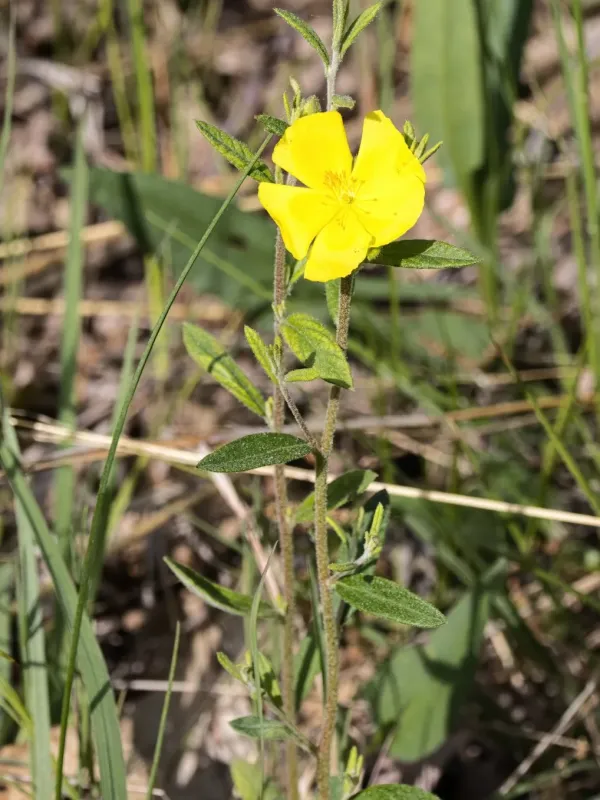
Canada frostweed (Helianthemum canadense) is a perennial herbaceous plant belonging to the Cistaceae family, typically reaching a height of 10 to 40 cm.
The stems are branched, and the leaves are alternate and oblong-lanceolate, featuring a distinct grayish-green appearance due to covering of tiny star-shaped hairs.
The plant exhibits dimorphic flowering: it produces large, yellow, five-petaled flowers that open in sunlight, and smaller, petal-less cleistogamous flowers.
Its root system is well-developed, allowing the plant to anchor firmly in sandy substrates and compete effectively for limited soil nutrients.
Identification is easiest during the summer flowering period, when the prominent yellow petals become highly visible amidst the surrounding vegetation.
Where it grows
This species thrives in open, sunny locations characterized by sandy or gravelly soils that are often poor in essential plant nutrients.
In its natural environment, it is commonly found on dry prairies, forest clearings, and coastal dunes, often appearing as a pioneer species on disturbed sites.
As a light-demanding plant, Canada frostweed is rarely found in dense, shaded crop stands but frequently invades field edges, fence lines, and uncultivated lands.
Its high drought tolerance makes it a persistent inhabitant of arid or well-drained habitats where other common weeds might struggle to survive.
Seed dispersal is mainly driven by wind and human activity, with seeds showing long-term viability in the soil seed bank, awaiting optimal conditions for germination.
Harm it causes
The weed acts as a strong competitor for water and mineral nutrients, which can significantly reduce the yield and quality of surrounding crops.
In pastures or permanent meadows, it can create dense mats that exclude desirable forage species, thereby reducing the nutritional value of the land.
Canada frostweed may serve as an alternative host for various crop pathogens, potentially increasing the risk of infection for neighboring agricultural plants.
Its presence at harvest time can interfere with mechanical harvesting equipment, leading to increased levels of green matter contamination in the grain.
By consuming limited resources in sandy fields, it hinders the establishment and initial growth of desired crop seedlings during the critical spring phase.
How to control
Effective management starts with deep fall plowing, which disrupts the perennial root structure and exposes the soil to weathering, hindering weed regrowth.
Implementing proper crop rotation strategies that include inter-row cultivation helps to suppress its development during the early stages of the growing season.
Chemical control remains a viable option, utilizing systemic herbicides applied during the plant's active vegetative growth phase for maximum efficiency.
- Regular mowing of field margins to prevent the weed from setting seed.
- Utilizing cover crops to shade out competitive areas and reduce weed vigor.
- Targeted herbicide applications on spot infestations to prevent spread into the main crop.
In cases of severe infestation, pre-plant or post-harvest applications of glyphosate-based systemic herbicides are recommended for long-term population control.
Taxonomy
- Latin name
- Helianthemum canadense
- Family
- Ладанниковые
- EPPO code
- HEACN