
Pale touch-me-not
Impatiens pallida
Description
How to tell it apart
Pale touch-me-not is an annual herbaceous plant belonging to the Balsaminaceae family, typically growing to a height of 60 to 150 centimeters.
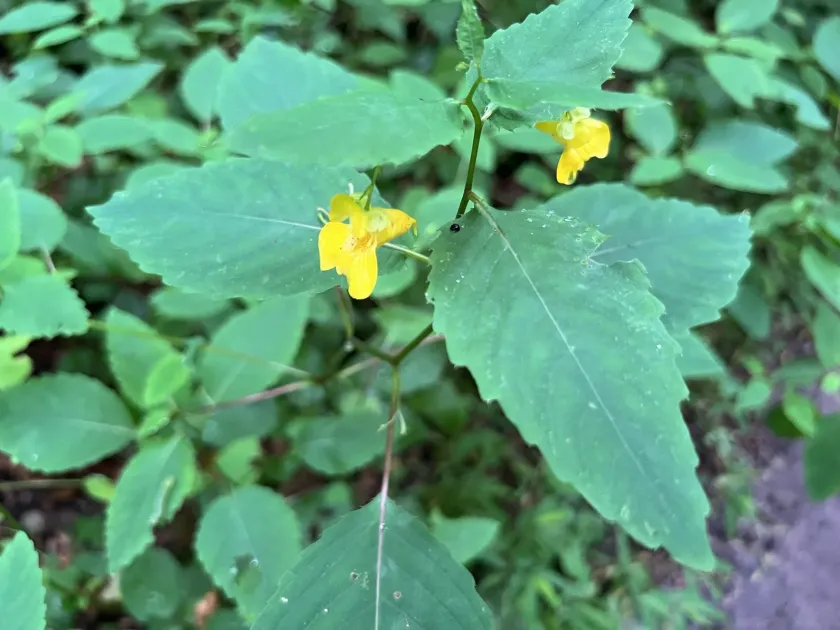
The stems are succulent, smooth, and somewhat translucent, often showing a yellowish-green color with swollen nodes where leaves attach.
The leaves are ovate to elliptical, with serrated margins and thin textures, arranged alternately along the branching, succulent stem.
The flowers are pale yellow, often speckled with small reddish-brown dots, featuring a distinct pouch-like shape with a short spur.
The plant is notorious for its seed capsules that explode upon mechanical contact when ripe, scattering seeds over a wide area.
Where it grows
This weed thrives in shady, moist environments, including forest edges, stream banks, ravines, and low-lying, damp areas of agricultural fields.
It is commonly found in sites with high soil moisture content, such as poorly drained spots in croplands or along the perimeter of agricultural drainage channels.
The plant is highly adaptive to disturbed habitats and can quickly colonize areas where natural vegetation has been removed or soil has been turned.
It prefers fertile, nutrient-rich soils and is frequently observed near water sources, benefiting from constant moisture availability for its rapid growth.
The species is widespread in temperate regions and often forms dense colonies that can alter the local plant community structure.
Harm it causes
The primary harm caused by pale touch-me-not is its rapid growth and competitive nature, which deprives neighboring crops of light, water, and nutrients.
Its presence in field margins can hinder the movement of farm machinery, creating obstacles that lead to inefficient harvesting and maintenance operations.
By maintaining high humidity levels within its dense stands, the weed creates microclimates that are favorable for the development of fungal pathogens.
Economic losses occur due to the reduction of crop yield and quality in infested areas, as the weed effectively chokes out surrounding vegetation.
In pastures or hay fields, the plant is generally undesirable and occupies space that could otherwise support nutritious fodder crops.
How to control
Effective control requires manual or mechanical removal of the plants before they reach the flowering and seed-setting stages to stop further propagation.
Improving field drainage is a critical cultural practice, as it addresses the core environmental condition that allows this weed to flourish.
Regular tillage and cultivation throughout the growing season are effective in destroying young seedlings before they develop a deep root system.
Chemical control involving selective herbicides may be necessary in severe infestations, though application must be careful near riparian zones.
Monitoring field edges and drainage ditches is essential for early detection and prevention of the spread of this invasive-prone species into cultivated areas.
Taxonomy
- Latin name
- Impatiens pallida
- Family
- Бальзаминовые
- EPPO code
- IPAPL