
Orange balsam
Impatiens capensis
Description
How to tell it apart
Orange balsam (Impatiens capensis) is an annual herbaceous plant in the Balsaminaceae family. It is known for its translucent, succulent, and fragile stems that frequently exhibit a reddish tint.
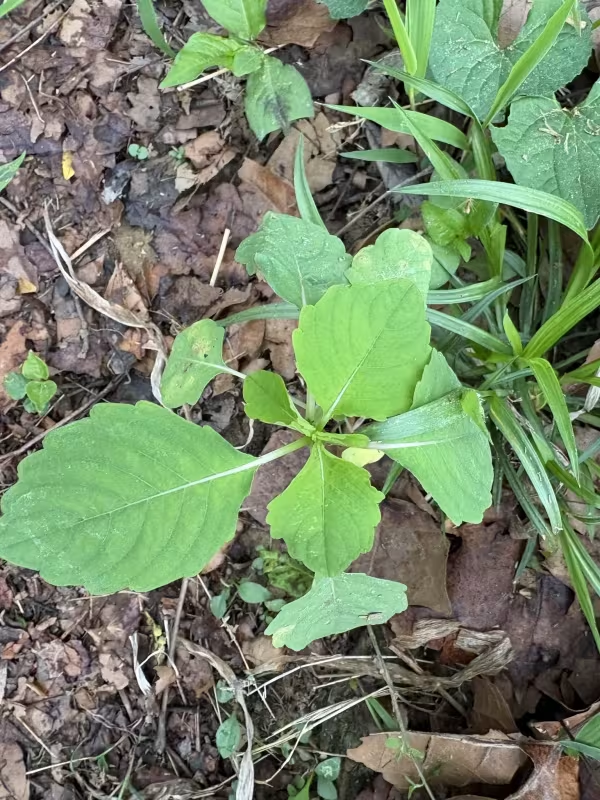
The leaves are alternate, ovate in shape, and possess serrated margins, which serve as a primary identification trait. The plant typically grows to heights ranging from 50 to 150 centimeters.
The flowers are distinctively shaped, featuring a curved spur and an orange-to-yellow hue decorated with reddish-brown spots inside the throat, making the species easily recognizable during the flowering season.
A key biological feature is the explosive seed dispersal mechanism. Upon contact, the mature seed pods burst, ejecting seeds over several meters, which allows for rapid colonization of nearby areas.
Its root system is shallow and fibrous, allowing the plant to anchor effectively in moist, loose soils, which supports its quick development of vegetative biomass throughout the growing season.
Where it grows
Orange balsam is primarily found in wetlands, stream banks, and damp, shaded environments. It thrives in soils with high moisture content and high water tables.
In agricultural settings, it frequently emerges in low-lying areas of fields, irrigation ditches, and areas adjacent to water bodies where water accumulates after rainfall or irrigation.
The species prefers nutrient-rich, moist soils. It is highly sensitive to drought; thus, it is rarely found in dry, well-drained upland areas, which limits its primary impact to specific field zones.
It acts as a colonizer of disturbed sites. Whenever natural vegetation is removed from wet ground, orange balsam quickly establishes itself before other competitive species can take over.
Because seeds are often dispersed by flowing water, the plant commonly spreads along drainage networks, posing a persistent challenge in irrigated farm landscapes.
Harm it causes
The primary damage caused by orange balsam is its strong competitive ability for space and light. Its dense growth habit leads to the shading of crops, particularly in low-growing vegetables.
Dense populations create a humid microclimate that favors the growth of fungal pathogens. These pathogens can easily spread from the weed to adjacent crops, increasing the risk of disease.
The presence of orange balsam during harvest time poses mechanical challenges. Its succulent, entangled stems can clog harvesting machinery, leading to reduced efficiency and potential downtime.
By consuming large amounts of water and soil nutrients, the weed exerts significant pressure on crops growing in moist field sectors, often leading to reduced yield and stunted growth.
The explosive seed dispersal ensures that once the plant is established, the seed bank in the soil grows rapidly, making it difficult to eradicate completely in subsequent seasons.
How to control
Effective management begins with soil and water management. Improving field drainage is the most sustainable approach, as the plant cannot survive in dry or well-drained conditions.
Mechanical control, such as shallow tillage, mowing, or hand pulling, is highly effective if conducted before the seed pods mature, as this breaks the cycle of seed dispersal.
Regular monitoring of irrigation channels and field edges is essential to prevent the spread of the plant from non-crop areas into the productive field zones.
Chemical control can be utilized as a supporting measure, applying selective herbicides where mechanical methods are impractical, provided the application strictly follows safety regulations.
- Improving drainage systems;
- Mechanical weeding before seed maturation;
- Regular mowing of non-crop areas;
- Targeted herbicide application.
Taxonomy
- Latin name
- Impatiens capensis
- Family
- Бальзаминовые
- EPPO code
- IPACA