
Stinking Pennywort
Hydrocotyle laxiflora
Description
How to tell it apart
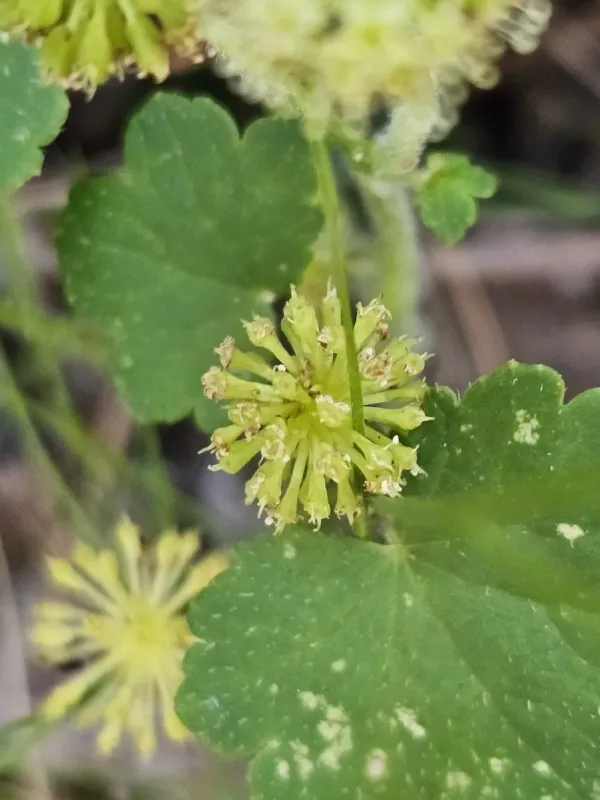
Stinking Pennywort (Hydrocotyle laxiflora) belongs to the Araliaceae family. It is a perennial herbaceous plant with creeping stems that root actively at the nodes, forming dense mats.
The leaves are rounded or kidney-shaped with a characteristic scalloped edge and long petioles. The surface of the leaf blade is often slightly pubescent, which serves as a key diagnostic feature.
The inflorescence is a loose umbel located on a long peduncle arising from the leaf axils. The flowers are small, greenish-white, making them inconspicuous against the dense foliage.
The root system is fibrous and well-developed, capable of regenerating vegetative mass even after partial damage during soil cultivation. The plant shows high plasticity to light conditions.
Seeds are small and easily dispersed by water and agricultural equipment, which facilitates the rapid spread of the weed to new areas within the agroecosystem.
Where it grows
This species prefers moist, shaded areas and is often found on field edges, along irrigation canals, and in low-lying areas. It is most aggressive in regions with a mild climate.
In field conditions, the weed often colonizes areas with excessive moisture, where competition from crops is reduced due to poor agricultural practices. It is also frequently found in pasture lands.
It infests perennial grasses, hayfields, and row crops when soil moisture control is inadequate. In dry conditions, the plant's development slows down, but it remains viable.
The plant demonstrates high adaptability to various soil types, including heavy clay soils that are prone to compaction and waterlogging after precipitation.
The presence of this species often indicates a need to improve the field's drainage system or optimize irrigation regimes to prevent the spread of weed hotspots.
Harm it causes
The primary damage lies in the creation of a dense carpet that suppresses crop seedlings during the early stages of growth, depriving them of access to light and nutrients.
Due to its creeping growth habit, the weed quickly captures available space, competing for moisture and soil nitrogen, which leads to a significant decrease in cereal and forage crop yields.
The weed acts as a reservoir for several pathogens and pests that can spread to agricultural crops, complicating the overall phytosanitary situation in the fields.
In pastures, the active expansion of this species leads to the displacement of valuable forage grasses, reducing the nutritional value of the plant mass and degrading the quality of hay.
Harvesting difficulties arise because the stems of the plant can clog the working parts of agricultural machinery, increasing maintenance costs and fuel consumption.
How to control
Mechanical control includes deep plowing with moldboard turnover, which helps destroy the root system and prevents further vegetative propagation of the creeping runners.
Regular discing during the active growth period helps deplete the nutrient reserves in the roots, significantly reducing the weed's regenerative capacity.
The use of systemic herbicides based on glyphosate is highly effective when treating areas with high infestation density before sowing operations begin.
Agronomic measures include improving field drainage, as reducing excessive moisture levels makes environmental conditions less favorable for this species to dominate.
- Timely inter-row cultivation.
- Adherence to crop rotation with weed-suppressing crops.
- Use of green manure crops to crowd out weed vegetation.
- Localized application of selective herbicides in crops.
Taxonomy
- Latin name
- Hydrocotyle laxiflora
- Family
- Аралиевые
- EPPO code
- HYDLA