
American pennywort
Hydrocotyle americana
Description
How to tell it apart
American pennywort (Hydrocotyle americana) is a member of the Araliaceae family. It is a perennial herbaceous plant characterized by thin, creeping, and branching stems that root easily at the nodes.
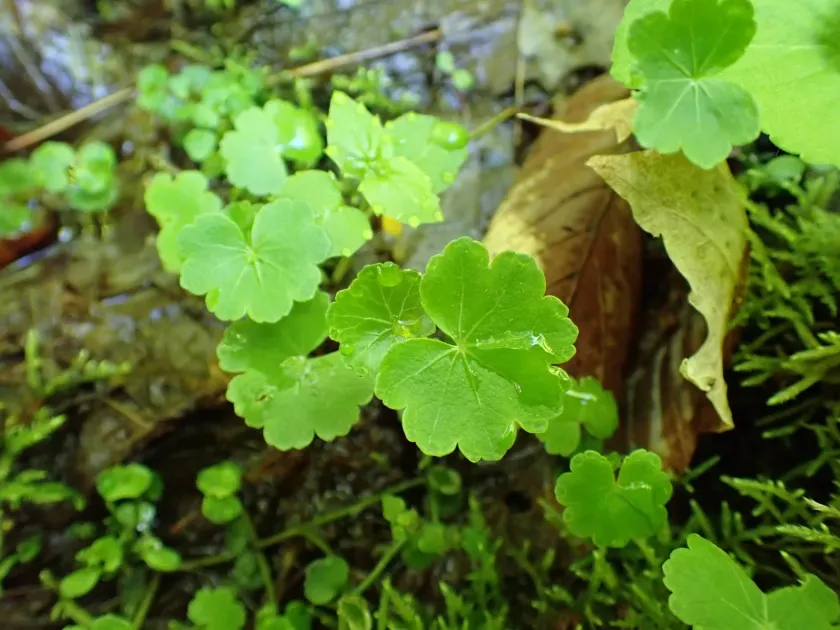
The leaves are alternate and borne on long petioles, displaying a distinctive kidney-shaped or circular form with a deep heart-shaped base. The margins of the leaves are typically crenate-toothed, a key diagnostic feature.
The inflorescences are simple umbels located on short stalks arising from the leaf axils. The flowers are extremely small, pale green or white, and nearly sessile.
The plant possesses a fibrous and well-developed root system capable of rapidly colonizing areas through aggressive vegetative propagation by creeping stems.
A biological feature of the species is its adaptation to moist environments, which makes it visually similar to other members of the family, though it differs in leaf plate size and inflorescence structure.
Where it grows
This weed predominantly grows in high-moisture environments, such as stream banks, marshy lowlands, wet forests, and the edges of poorly drained agricultural fields.
In the agricultural sector, American pennywort is most commonly found in crops requiring intensive irrigation or in waterlogged fields where drainage is inadequate.
The plant actively colonizes drainage ditches and irrigation channels, hindering the flow of water and indirectly worsening conditions for the primary crop.
Dissemination occurs both through seeds carried by water and by fragments of stems transported by soil movement or farming equipment.
It prefers shaded or semi-shaded sites with organic-rich soil, yet it successfully adapts to open areas provided there is sufficient moisture.
Harm it causes
The primary damage is caused by intense competition for water and nutrients, especially during the critical early stages of crop development.
Due to its ability to form a dense mat of stems rapidly, American pennywort suppresses crop growth by limiting access to sunlight and space.
The presence of this weed complicates mechanized field operations, as the wet soil conditions associated with its growth inhibit tractor movement.
The weed acts as an alternative host for certain pests and plant pathogens, which can migrate to crops and increase the overall disease pressure.
In fields with small-seeded crops, American pennywort can cause critical yield reductions by creating persistent patches of heavy infestation that are difficult to eradicate.
How to control
Effective control requires an integrated approach starting with the improvement of site drainage and leveling of the field surface to prevent water accumulation.
Agronomic methods include regular deep plowing and cultivation, which disrupt the root system and inhibit the plant's ability to reproduce vegetatively.
A vital practice is the timely cleaning of drainage ditches and surrounding areas to prevent the spread of the weed through seeds or vegetative propagules.
Chemical control involves the use of systemic herbicides applied to actively growing foliage, although efficacy may be limited by the waxy cuticle of the leaves.
- Application of glyphosate-based herbicides in non-selective spraying programs.
- Implementation of crop rotation including crops that require intensive inter-row cultivation.
- Strict monitoring of seed purity to prevent accidental introduction into new fields.
Taxonomy
- Latin name
- Hydrocotyle americana
- Family
- Аралиевые
- EPPO code
- HYDAM