
Shaggy hawkweed
Hieracium villosum
Description
How to tell it apart
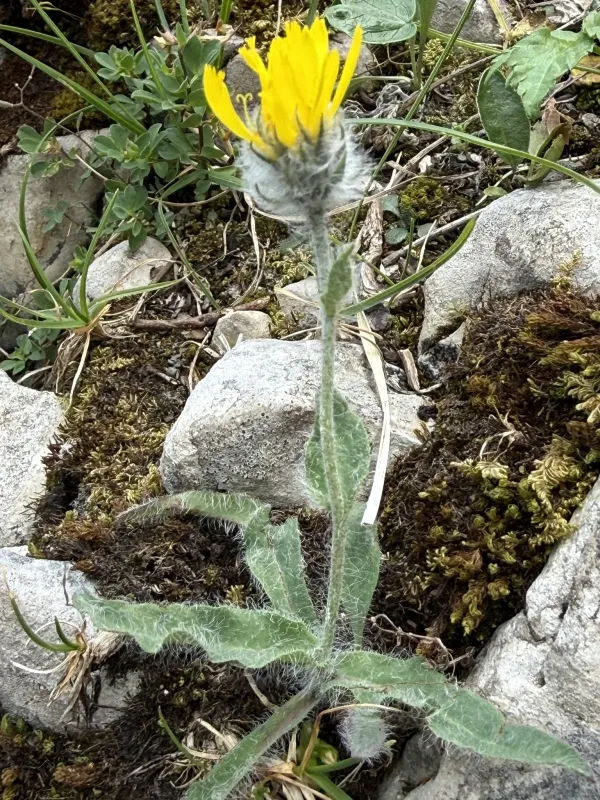
Shaggy hawkweed (Hieracium villosum) is a perennial herbaceous plant belonging to the Asteraceae family. It is easily recognized by the dense, silvery-white hairs covering its stems and leaves, which give it a distinctive shaggy appearance.
The plant grows as a basal rosette of lance-shaped leaves, from which a flowering stem emerges, reaching heights of up to 30–40 cm. It produces large, bright yellow flower heads typical of the Hieracium genus.
It possesses a strong, branched root system that allows it to survive in harsh, rocky, or nutrient-poor soils. The plant reproduces both via seeds and through vegetative growth from its rootstock.
In the field, it is important to distinguish this species from other hawkweeds, although the intense white pubescence is a primary diagnostic feature of the shaggy variety.
Flowering occurs in the mid-to-late summer, followed by the development of seeds equipped with pappus, which facilitate wind dispersal across wide areas.
Where it grows
This species thrives in open, sunny environments. It is commonly found on mountain slopes, stony screes, dry meadows, and pastures characterized by calcareous soils.
In agricultural settings, Shaggy hawkweed can infest perennial pastures, where it competes aggressively for water and nutrients with more valuable forage grasses.
It frequently colonizes non-cropped areas such as field margins, roadsides, and abandoned lands, from where it gradually invades adjacent crop fields.
The plant shows high ecological resilience, allowing it to colonize even sandy or degraded soils that are otherwise unsuitable for many cultivated crops.
Wind-aided seed dispersal is the primary cause of its rapid spread into new areas, making it essential to monitor field edges and surrounding waste areas.
Harm it causes
The main impact of Shaggy hawkweed lies in its ability to quickly dominate a site, effectively suppressing the growth of valuable forage species in pastures and hayfields.
As a competitor for soil moisture and nutrients, it reduces the overall productivity of cultivated crops growing in its vicinity, leading to yield losses.
Due to its dense hair covering, livestock typically avoid grazing it, which reduces the feed quality of the pasture and may lead to a total loss of grazing capacity over time.
In established perennial stands, the weed can displace desirable plants, causing the degradation of the pasture and necessitating costly mechanical or chemical intervention.
Furthermore, Shaggy hawkweed can harbor certain pests and pathogens that may affect other Asteraceae-family crops, thereby complicating integrated pest management strategies.
How to control
The most effective agrotechnical control method is deep plowing, which disrupts the plant's root system and prevents vegetative spread in the following season.
Timely mowing before the plant reaches the flowering stage is crucial to prevent seed production and limit the spread of the weed across the farm.
Chemical control involving systemic herbicides (e.g., those containing 2,4-D or dicamba) is recommended for large infestations, as these products are effective against perennial broadleaf weeds.
In pastures, promoting a dense and vigorous growth of forage grasses through fertilization and overseeding can significantly suppress the establishment of hawkweed seedlings.
- Implement regular field margin maintenance.
- Use selective herbicides per application labels.
- Practice mechanical root removal in small patches.
- Boost soil fertility to increase crop competitiveness.
- Monitor for new infestations during early spring.
Taxonomy
- Latin name
- Hieracium villosum
- Family
- Сложноцветные (астровые)
- EPPO code
- HIEVI