
King devil
Hieracium praealtum
Description
How to tell it apart
King devil (Hieracium praealtum) is a perennial herbaceous plant belonging to the Asteraceae family, often forming dense patches or mats.
The leaves form a basal rosette, are lanceolate or linear-lanceolate in shape, and are covered with distinctive stiff hairs that give the plant a grayish-green appearance.
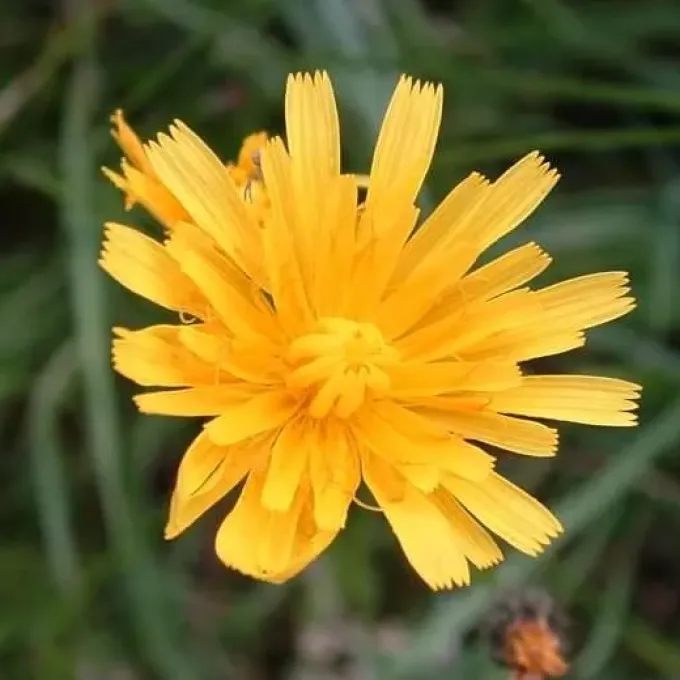
The stems are erect, usually leafless or with small bracts, growing between 30 and 70 cm in height, and terminate in showy yellow flower heads.
These flower heads are arranged in a dense corymb-like inflorescence, blooming primarily during the first half of the summer season.
The plant possesses a vigorous root system with creeping rhizomes or stolons, allowing it to spread rapidly and dominate the soil surface.
Where it grows
This species prefers dry, sandy, or gravelly soils and is commonly found in meadows, pastures, forest edges, and along roadsides.
In agricultural settings, King devil often infests perennial grass crops, fallow fields, and areas where crop rotation is neglected.
Its high ecological plasticity enables it to successfully compete with forage grasses and cultivated crops for soil moisture and nutrients.
Propagation occurs mainly through vegetative spread via stolons, though seed dispersal by wind also allows the weed to colonize new fields.
King devil is particularly invasive in low-maintenance pastures or fields where the crop canopy is too sparse to suppress the growth of weeds.
Harm it causes
King devil significantly degrades the quality of hayfields and pastures by outcompeting and eventually replacing valuable forage grass species.
The aggressive vegetative expansion forms dense mats that prevent the emergence and development of desirable agricultural or forage plants.
The root system aggressively depletes soil moisture and nitrogen, directly reducing the yield potential of crops grown in infested areas.
Its coarse, hairy foliage makes it unpalatable for livestock, and in some cases, the trichomes may cause mild irritation or allergic reactions in animals.
Infestation complicates mechanical harvesting operations and necessitates expensive chemical or mechanical interventions to restore field productivity.
How to control
Effective agrotechnical control requires deep autumn plowing with soil inversion, which disrupts the root system and prevents resprouting.
Frequent disking in fallow fields is an essential strategy to exhaust the energy reserves stored within the weed's rhizomes.
Rotating infested fields with row crops allows for regular inter-row cultivation, which physically destroys the rosettes and stems of the plant.
Chemical control can be achieved using systemic herbicides, specifically those targeting perennial broad-leaved weeds, applied during active growth.
- Mowing before the flowering stage is critical to prevent seed production and further spread.
- Establishing competitive cover crops helps to shade out the weed and limit its expansion.
Taxonomy
- Latin name
- Hieracium praealtum
- Family
- Сложноцветные (астровые)
- EPPO code
- HIEPD