
Lachenal's hawkweed
Hieracium lachenalii
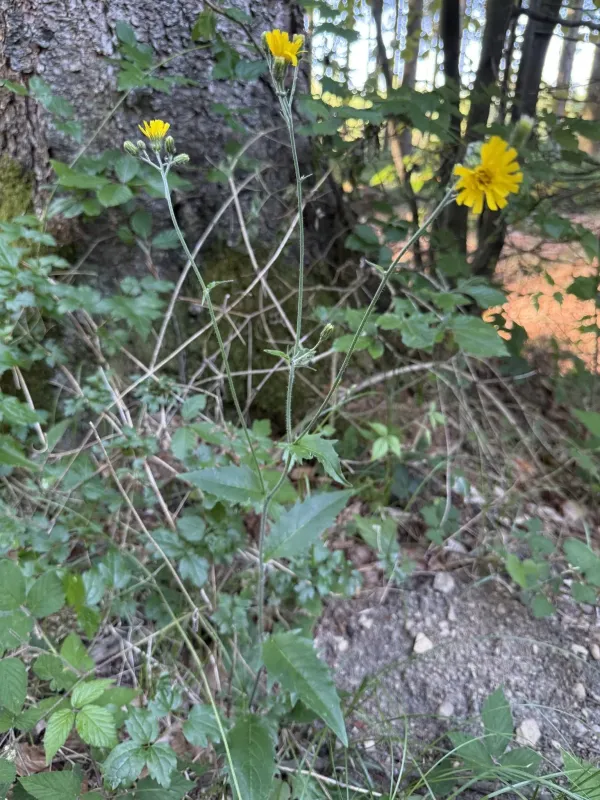
Description
How to tell it apart
Lachenal's hawkweed (Hieracium lachenalii) is a perennial herbaceous plant belonging to the Asteraceae family. It is classified as a rhizomatous weed, known for its ability to persist and spread despite various environmental challenges.
The plant typically grows to a height of 30 to 60 cm. Its leaves are lanceolate to ovate-lanceolate, usually featuring toothed edges, with a basal rosette that remains present throughout most of the growing season.
The stems and foliage are often covered in simple and glandular hairs, which is a key identifying characteristic. This pubescence helps the plant reduce water loss and protects it from certain herbivores.
The inflorescence consists of yellow flower heads arranged in a loose, corymb-like structure. The involucral bracts of the flower heads are distinct due to the presence of glandular hairs, separating it from other hawkweed species.
Reproduction is primarily achieved through wind-dispersed seeds equipped with a pappus, although it can also propagate vegetatively via its robust, spreading root system, allowing it to colonize new areas rapidly.
Where it grows
Lachenal's hawkweed is commonly found in forest edges, meadows, pastures, and along roadsides. In agriculture, it frequently invades disturbed lands, fallow fields, and areas where perennial grasses are grown.
It prefers acidic, low-fertility soils, making it an indicator species for specific soil conditions. The plant thrives in areas where the turf layer has been disrupted by overgrazing or poor management practices.
In cultivated fields, this weed competes fiercely with crops for sunlight, nutrients, and moisture. It is particularly problematic in fields with minimal tillage, as the roots are not disturbed frequently enough to control its spread.
The weed is highly plastic in terms of ecology, allowing it to adapt to various climatic zones. Its seeds can remain dormant in the soil for extended periods, waiting for optimal conditions to germinate.
Infestation often starts from the edges of fields and roads, spreading inward if the field borders are not maintained. The ability of this weed to withstand poor conditions makes it a difficult challenge for growers.
Harm it causes
The primary harm caused by Lachenal's hawkweed is its aggressive competition with crops for essential resources. It can significantly suppress the growth of young seedlings, reducing plant density and crop yield.
Its deep and extensive root system depletes the topsoil of nutrients, making it harder for crops to reach their full potential even if fertilizers are applied. This leads to higher costs and lower returns for farmers.
The presence of this weed interferes with mechanized harvesting. The dense leaf rosettes and tough stems can clog machinery, increase wear and tear, and lead to higher grain moisture due to green material contamination.
It can also act as an alternate host for various plant pathogens and pests, potentially increasing the disease pressure within a field. This necessitates additional chemical or cultural treatments for the main crop.
In grazing lands, Lachenal's hawkweed reduces the availability of palatable forage for livestock. This decreases the overall carrying capacity of the pasture and may lower the nutritional quality of the hay produced.
How to control
Managing Lachenal's hawkweed requires a multi-faceted approach, starting with deep tillage. Turning the soil helps expose and dry out the root systems, which is crucial for reducing its vegetative spread.
Crop rotation is essential for long-term control. Integrating row crops that require frequent cultivation helps disrupt the plant’s growth cycle and prevents the establishment of new rosettes.
Chemical control can be highly effective when applied to fields under fallow or during the post-harvest period. Systemic herbicides like glyphosate are standard for destroying the entire plant, including the underground parts.
Selective herbicide applications in growing crops should be chosen based on the crop type and the specific life stage of the weed. Always ensure compliance with safety and environmental regulations when applying chemicals.
- Regular mechanical cultivation to deplete root energy reserves.
- Maintaining competitive crop cover to shade out weed seedlings.
- Cleaning equipment to prevent seed dispersal between fields.
- Mowing field borders before flowering to prevent seed set.
Taxonomy
- Latin name
- Hieracium lachenalii
- Family
- Сложноцветные (астровые)
- EPPO code
- HIELA