
Gundelia tournefortii
Gundelia tournefortii
Description
How to tell it apart
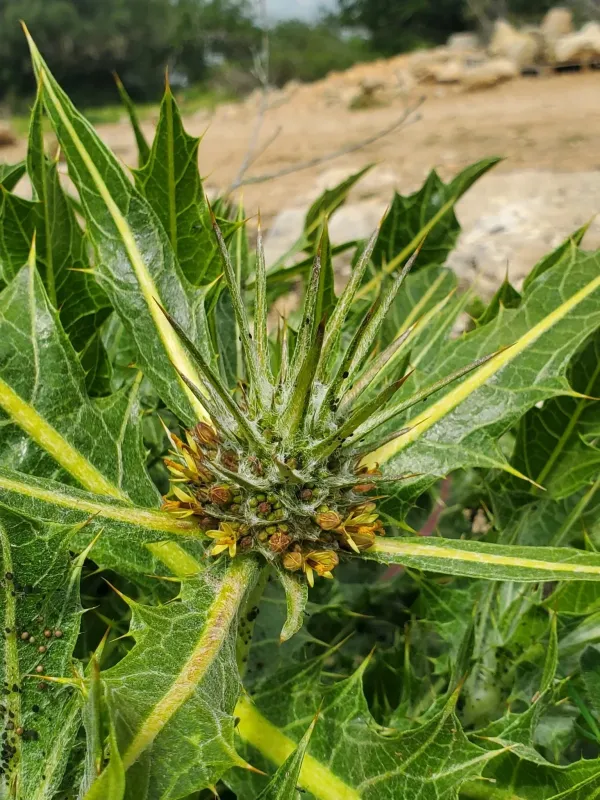
Gundelia tournefortii is a perennial herbaceous plant belonging to the Asteraceae family, characterized by a deep, thick taproot. It appears as a prickly bush with dense, deeply lobed leaves covered in fine, cobweb-like hairs.
The inflorescence consists of a large, globular head surrounded by stiff, sharp bracts. This structure makes the plant difficult to manage manually and provides protection against herbivores.
Flowers are typically yellow or reddish, clustered within the prickly heads. The plant exhibits high biological plasticity, allowing it to thrive in diverse and often harsh environmental conditions.
Seeds are encased in a tough, durable coat that ensures viability in the soil for several years. This dormancy period makes the plant particularly persistent in cultivated fields.
The extensive root system allows the plant to reach deep groundwater reserves, enabling it to outcompete crops during periods of severe drought.
Where it grows
This species is widely distributed across the Middle East, Central Asia, and Mediterranean regions. It is commonly found on fallow lands, pastures, roadsides, and abandoned fields.
Gundelia causes significant damage to grain crops, vegetable plantations, and orchards. Its drought-resistant nature allows it to quickly colonize fields in semi-arid climates.
The plant prefers open, sunny locations with sandy or rocky soils, yet it adapts well to various soil types, including saline environments, which increases its invasive potential.
In modern agriculture, Gundelia often invades new areas via contaminated seeds or through irrigation water, rapidly forming dense patches that are difficult to eradicate.
Overgrazing by livestock contributes to its spread, as animals avoid the thorny foliage, effectively leaving the weed to dominate the pasture ecosystem.
Harm it causes
Gundelia tournefortii causes major economic losses by competing with crops for water, essential nutrients, and sunlight, leading to significant reductions in harvest yields.
The prickly debris of the plant complicates mechanical harvesting, causes damage to machinery components, and increases the post-harvest costs of cleaning grains from weeds.
On grazing lands, the weed outcompetes nutritious fodder, decreasing the overall productivity of the pastures and hindering the movement of livestock.
The plant serves as a reservoir for various pathogens and pests that can migrate to agricultural crops, necessitating additional chemical interventions.
- Competition with crops for limited resources.
- Physical damage to harvesting equipment.
- Contamination of raw agricultural produce.
How to control
Mechanical control starts with deep plowing, which effectively severs the taproot and disrupts the vegetative propagation cycle of the weed in the soil.
Implementing a proper crop rotation system using competitive crops that shade the soil is a vital cultural practice to suppress early seedling development.
Chemical control involves the use of systemic herbicides, particularly glyphosate-based products, applied during the active growth phase before the flower heads develop.
In selective crop protection, specific herbicides for broad-leaved weeds may be used, although repeated applications are often required due to the high resistance of the weed.
Monitoring field margins and preventing seed dispersal via farm machinery are crucial steps in managing the spread of this invasive and resilient plant.
Taxonomy
- Latin name
- Gundelia tournefortii
- Family
- Сложноцветные (астровые)
- EPPO code
- GUNTO