
Marsh cudweed
Gnaphalium uliginosum
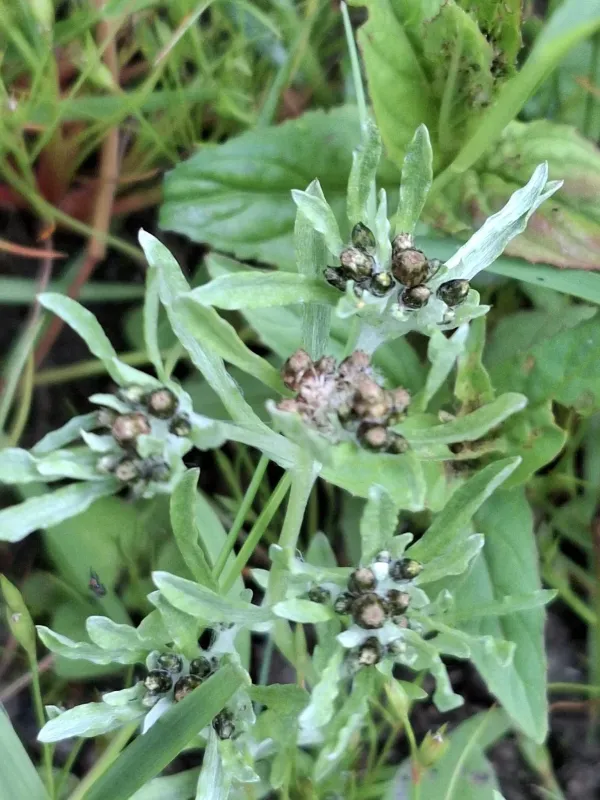
Description
How to tell it apart
Marsh cudweed (Gnaphalium uliginosum) is an annual herbaceous plant belonging to the Asteraceae family. It is a small weed that is often overlooked until it colonizes large areas.
The stems are typically 5–20 cm long, branching from the base and spreading to form dense mats. The entire plant is covered with a thick, whitish-grey woolly tomentum.
The leaves are linear-lanceolate, alternate, and narrowed at the base. Their grey-green appearance is a result of the dense hairs covering both surfaces of the leaf blades.
Flowers are arranged in small, crowded heads at the ends of the branches. The bracts surrounding the flowers are brownish, which helps distinguish it from other related species.
It possesses a shallow taproot system that is highly effective in saturated soils, allowing the plant to survive in wet conditions where other weeds might perish.
Where it grows
This weed is commonly found in damp areas, including riverbanks, ditches, and low-lying, poorly drained fields. It thrives in soils with high moisture content.
In agricultural settings, it is a nuisance in fields with heavy clay soils or areas prone to temporary waterlogging following heavy rainfall or irrigation.
It is frequently observed in various cropping systems, including cereals and row crops, particularly in depressions within the field where water accumulates.
Dispersal is primarily through seeds, which are easily transported by water runoff, machinery movement, and occasionally through soil contamination on equipment tires.
The presence of marsh cudweed acts as a biological indicator of soil drainage issues, suggesting the need for soil surface leveling or improved field drainage.
Harm it causes
The primary damage caused by marsh cudweed is the competition for water and soil nutrients, which stunts the growth of neighboring crops during critical development stages.
High infestations lead to reduced crop stand establishment, as the weed forms a dense ground cover that prevents crop seeds from reaching optimal germination conditions.
Its woolly foliage retains moisture, creating a micro-environment that can promote the incidence of fungal diseases in the crop canopy.
Harvesting efficiency is reduced due to weed biomass interfering with machinery, leading to the contamination of harvested grain and increased post-harvest drying costs.
Because each plant produces thousands of seeds, a small initial population can quickly dominate large areas if not addressed early in the season.
How to control
Cultural control is the most sustainable approach, focusing on improved land leveling and subsurface drainage to prevent stagnant water in the field.
Mechanical operations, such as shallow inter-row cultivation in row crops, are very effective if performed before the plant begins to produce seeds.
Chemical control involves the use of registered herbicides, typically broad-leaf selective herbicides used in cereal crop protection strategies.
Integrated weed management should include field sanitation, ensuring that equipment is cleaned when moving from infested zones to clean areas of the farm.
- Use clean, certified seeds to prevent introduction.
- Practice proper crop rotation to minimize weed niche availability.
- Implement preventative measures such as drainage maintenance.
Taxonomy
- Latin name
- Gnaphalium uliginosum
- Family
- Сложноцветные (астровые)
- EPPO code
- GNAUL