
Pennsylvania cudweed
Gamochaeta pensylvanica
Description
How to tell it apart
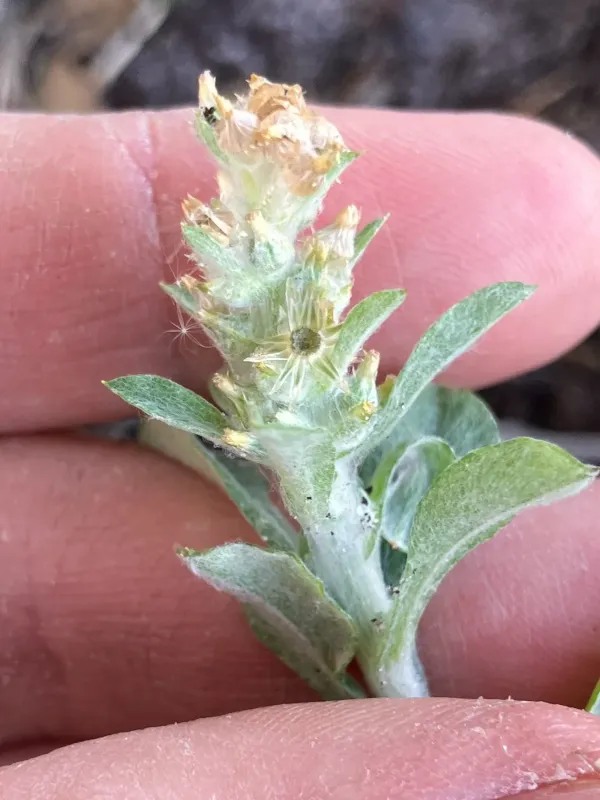
Pennsylvania cudweed (Gamochaeta pensylvanica) is an herbaceous plant belonging to the Asteraceae family. It is recognized by its dense, white, woolly-tomentose hairs on the underside of its leaves, which provides a distinct silvery appearance.
The plant typically grows in a basal rosette form before developing erect, branching stems that can reach heights of 10 to 40 centimeters. The leaves are generally lanceolate, with the upper surfaces often being darker green compared to the felted underside.
Flower heads are small, arranged in tight, spike-like or head-like inflorescences at the top of the stems. The bracts surrounding the flowers are often papery and can exhibit brownish or purplish tinges, contributing to the plant's overall appearance.
Reproduction is primarily through small, wind-dispersed seeds equipped with a pappus, allowing for wide distribution across agricultural landscapes. The biology of the species enables it to behave as an annual or biennial weed depending on climate.
Correct identification is crucial during the rosette stage, as the plant can be easily confused with other cudweed species. The specific arrangement of flowers and leaf texture are the primary diagnostic features for agronomists.
Where it grows
This weed commonly thrives in disturbed areas such as roadsides, fallow fields, and orchards. It shows a preference for open, sunlit environments and can establish itself on various soil types, particularly in compacted ground.
In cropping systems, it is often found in winter cereals, perennial pastures, and early-planted row crops. Its ability to colonize fields in the autumn makes it a persistent issue for winter crop establishment.
The species is highly adaptable and has successfully spread across various regions globally, often becoming a significant component of the weed flora in temperate and subtropical agricultural systems.
Harm it causes
The primary harm caused by Pennsylvania cudweed is its competition for nutrients and moisture during the critical early development stages of crops. Dense infestations can significantly reduce the potential yield of sown crops.
As a weed that remains green and active during cooler seasons, it acts as a host for various agricultural pests and viral vectors. This can lead to secondary problems, increasing the need for pesticide applications across the field.
How to control
Mechanical control through thorough tillage and seedbed preparation is highly effective. Cultivating at the early seedling stage, before the plant establishes deep roots, is essential to minimize its population density.
Chemical control involving systemic herbicides is widely used in field crops. It is most effective when applied early in the growth cycle, specifically when the weed is in the rosette stage and actively growing.
Crop rotation is a vital management strategy. Including competitive crops that can quickly cover the ground helps to suppress the growth of Pennsylvania cudweed by limiting its access to light.
Sanitation of field borders and adjacent non-cropped areas is necessary to prevent seed influx. Managing soil structure to prevent extreme compaction can also help reduce the suitability of the habitat for this weed.
Integrated weed management programs, combining timely cultivation, crop competition, and targeted herbicide application, are recommended to maintain Pennsylvania cudweed below economic injury levels.
Taxonomy
- Latin name
- Gamochaeta pensylvanica
- Family
- Сложноцветные (астровые)
- EPPO code
- GNAPE