
Common cudweed
Filago germanica
Description
How to tell it apart
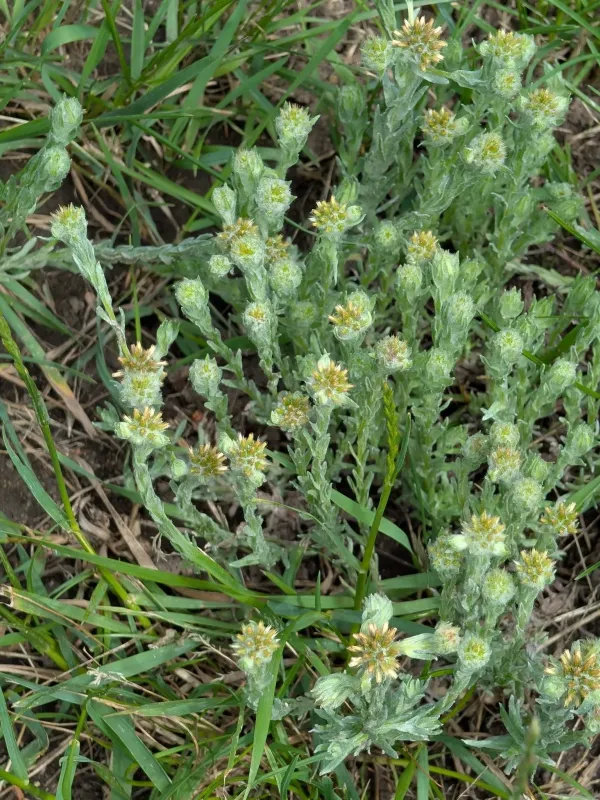
Common cudweed (Filago germanica) is an annual plant belonging to the Asteraceae family. It is easily recognized by its greyish-green appearance caused by dense, woolly, or tomentose hair covering its stems and leaves.
The plant grows to a height of 10–30 cm and features an erect, branched stem. Its leaves are alternate, linear-lanceolate, and have entire margins, often appearing quite crowded along the stem.
Its inflorescences consist of small flower heads clustered into dense, globular balls at the tips of the stems and branches, which are surrounded by leafy bracts.
It possesses a strong taproot system, which helps it establish itself effectively in thin or depleted soils where other vegetation might struggle to survive.
The reproduction is purely by seeds, which are extremely lightweight and equipped with mechanisms for wind dispersal, allowing the plant to spread rapidly across disturbed areas.
Where it grows
This weed prefers open, sunny, and dry conditions. It is commonly found in sandy or gravelly soils, fallow fields, and disturbed wasteland areas where competition from other flora is low.
In agricultural settings, it is frequently observed in cereal crops and pasture land, especially in regions where soil fertility is low or cultivation practices have been neglected.
Common cudweed thrives in fields with poor rotation and minimal soil coverage, taking advantage of open gaps in the canopy to complete its life cycle quickly.
It is often seen along field margins, roadsides, and in areas where the natural soil structure has been disrupted, providing ideal germination sites for its seeds.
The plant is highly resilient to environmental stress, including drought and low nutrient levels, allowing it to colonize marginal lands within the farm boundary.
Harm it causes
The primary damage caused by common cudweed is direct competition with crops for water and mineral nutrients, especially during the early stages of crop establishment.
High infestation levels can lead to stunted crop growth, as the weed quickly utilizes the available resources in the topsoil, depriving the primary crop of necessary inputs.
Its presence in field margins can serve as a reservoir for weed seeds, which annually re-infest the main crop area, increasing the long-term weed pressure on the farm.
Common cudweed can interfere with the harvest process, particularly when it grows in significant clumps, potentially reducing the efficiency of mechanical harvesting equipment.
Furthermore, seeds contaminating the harvested grain decrease the overall market value of the crop and necessitate additional cleaning processes at storage facilities.
How to control
Cultural control starts with vigorous seedbed preparation, which includes shallow cultivation to trigger germination and subsequent destruction of young seedlings before crop planting.
Maintaining crop vigor through optimal fertilization and correct sowing density is essential, as a dense crop canopy will naturally suppress the growth of this weed.
Chemical control is most effective when applied at the seedling stage using selective broadleaf herbicides recommended for use in the specific crop currently being grown.
Preventing the weed from setting seed is a vital strategy; this includes regular mowing of field borders and non-crop areas to stop the spread of seeds by wind.
- Pre-planting cultivation and harrowing.
- Application of selective herbicide programs.
- Crop rotation with competitive cultivars.
Taxonomy
- Latin name
- Filago germanica
- Family
- Сложноцветные (астровые)
- EPPO code
- FILVU