
Joe-Pye weed
Eupatorium fistulosum
Description
How to tell it apart
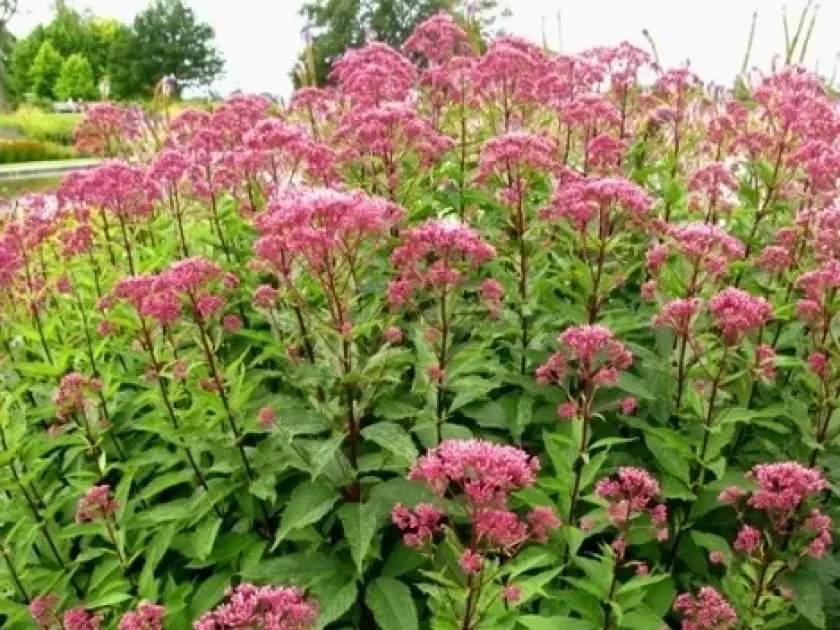
Joe-Pye weed (Eupatorium fistulosum) is a robust perennial plant belonging to the Asteraceae family. It is easily recognized by its hollow, smooth, and often purple-spotted stems.
The leaves are arranged in whorls, typically 4 to 6 per node. They are lance-shaped with serrated margins, adding to the plant's distinctive architectural appearance.
The flowers are clustered in large, dense, dome-shaped panicles that display shades of pink to purplish-lavender, highly attractive to pollinators during mid-to-late summer.
It possesses an extensive fibrous root system with thick rhizomes, which contributes to its aggressive vegetative spread in favorable soil conditions.
This plant can grow significantly tall, often reaching heights of 7 to 10 feet, allowing it to easily overtop and shade out competing vegetation.
Where it grows
This species thrives in moist environments, including river bottoms, floodplains, wet meadows, and the edges of forest habitats where moisture is constant.
In agricultural settings, it becomes a problematic weed in low-lying fields, riparian buffer zones, and areas with poor drainage or high water tables.
It frequently colonizes abandoned lands, pastures, and drainage ditches, quickly establishing dense colonies that exclude other plant species.
Its ecological adaptability allows it to persist in various soil types provided there is sufficient hydrological support during the growing season.
Seeds are wind-dispersed, allowing the plant to rapidly invade nearby cultivated areas from adjacent ditches or naturalized wetlands.
Harm it causes
The primary agricultural impact of Joe-Pye weed is its intense competition for space, moisture, and soil nutrients, which reduces the yields of nearby crops.
Its massive height and foliage density effectively block sunlight from reaching smaller or younger crop plants, severely limiting their photosynthetic capacity.
The dense, woody root systems are difficult to penetrate with standard tillage equipment, causing potential damage to machinery and requiring high power for cultivation.
When present in pastures, the plant may reduce grazing efficiency and, while generally not highly toxic, its presence in quantity is undesirable for forage production.
Dense stands of this weed provide a microclimate that serves as a reservoir for various pests and fungal pathogens, potentially increasing the disease pressure on adjacent fields.
How to control
Mechanical control focuses on deep tillage and consistent cultivation to disrupt and desiccate the rhizomatous root system, preventing plant regrowth.
Improving field drainage is a critical cultural practice, as it directly addresses the moisture requirements that allow this plant to dominate a site.
Regular mowing prior to the flowering stage is effective in preventing seed dispersal, though it must be repeated to starve the roots over multiple growing seasons.
Chemical management involves the use of systemic herbicides applied to the foliage during the period of active vegetative growth to ensure translocation to the roots.
- Deep tillage in autumn to expose root systems.
- Systemic herbicide application during the peak growth phase.
- Improved land drainage to alter habitat suitability.
- Mowing before seed head formation to limit reproductive success.
Taxonomy
- Latin name
- Eupatorium fistulosum
- Family
- Сложноцветные (астровые)
- EPPO code
- EUPFI