
Centaurea paniculata
Centaurea paniculata
Description
How to tell it apart
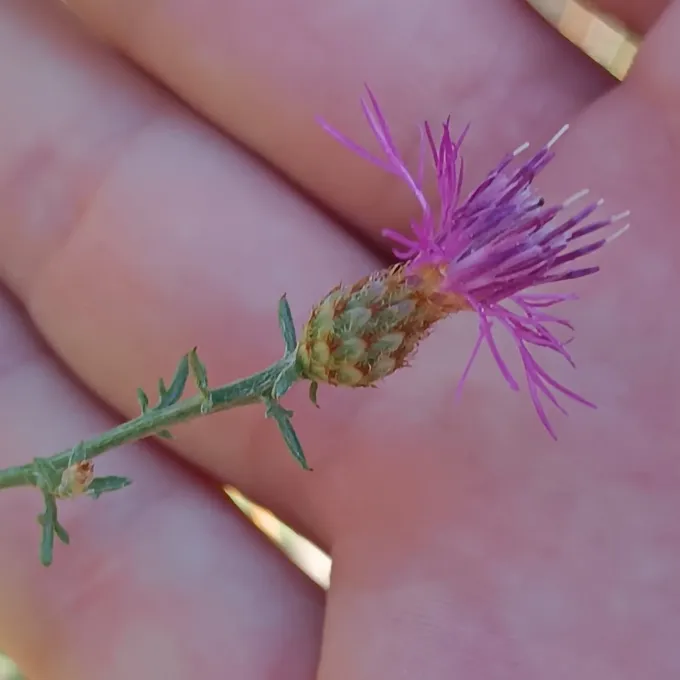
Centaurea paniculata, commonly known as panicled knapweed, is a perennial herbaceous plant belonging to the Asteraceae family. It features a robust taproot and a highly branched stem that grows up to 100 cm in height.
The leaves are pinnately lobed and possess a greyish-green appearance due to dense hairiness. Basal leaves form a rosette, while stem leaves become progressively smaller towards the inflorescence.
The flowers are arranged in small, panicle-like clusters of flower heads. The florets are typically purple, lilac, or pink, making the plant visually distinct during the summer flowering period.
Seeds are equipped with small bristles (pappus), facilitating wind dispersal across agricultural landscapes. This reproductive strategy makes it a highly invasive species in some environments.
The plant is adapted to survive harsh conditions, demonstrating significant resilience during periods of drought and nutrient scarcity in the soil profile.
Where it grows
Centaurea paniculata thrives in dry, sandy, or rocky habitats, including pastures, abandoned fields, and roadsides. It prefers well-drained soils and open areas with high sunlight exposure.
In agricultural settings, it competes in winter cereals, legumes, and perennial grasslands. It is particularly problematic in fields where the crop stand is not sufficiently dense.
The weed frequently colonizes marginal lands and field edges, serving as a reservoir for further spreading into productive areas of the farm via wind or machinery.
Its ability to tolerate low-fertility soils allows it to establish quickly on neglected or under-managed agricultural plots, becoming a dominant component of the local flora.
Seeds can persist in the soil seed bank for extended periods, emerging whenever soil disturbance or favorable climatic conditions provide a window for growth.
Harm it causes
The primary damage caused by panicled knapweed is the intense competition for soil moisture and nutrients, which leads to stunted growth and reduced grain yields in cereal crops.
The root system aggressively extracts water, making the crop more susceptible to drought stress. This can cause significant yield losses, especially in regions with limited rainfall.
The presence of knapweed in harvested crops creates physical contamination, increasing the costs associated with cleaning, drying, and grading grain for market specifications.
In pasture ecosystems, the plant reduces the quality of forage. Its coarse, rigid stems make the vegetation less palatable for livestock, thereby decreasing the stocking rate capacity.
Continuous presence of this weed can lead to long-term soil depletion, necessitating increased investment in fertilizers and soil health management to maintain high productivity levels.
How to control
Mechanical control involves thorough tillage and plowing, which are essential to disrupt the taproot system and prevent the establishment of deep-seated perennial plants.
A well-planned crop rotation is crucial. Integrating dense-growing crops helps shade out weed seedlings, limiting their growth potential in the early stages of development.
Chemical control should focus on systemic herbicides, such as those targeting broadleaf weeds, applied during the rosette stage to maximize effectiveness before the plant bolts.
Field sanitation is critical: preventing seed maturation by mowing or grazing field margins effectively reduces the pressure on the primary crop area.
- Use high-quality, weed-free seeds.
- Implement precise fertilizer application to boost crop vigor.
- Apply herbicides according to local agricultural guidelines.
Taxonomy
- Latin name
- Centaurea paniculata
- Family
- Сложноцветные (астровые)
- EPPO code
- CENPN