
Centaurea macrocephala
Centaurea macrocephala
Description
How to tell it apart
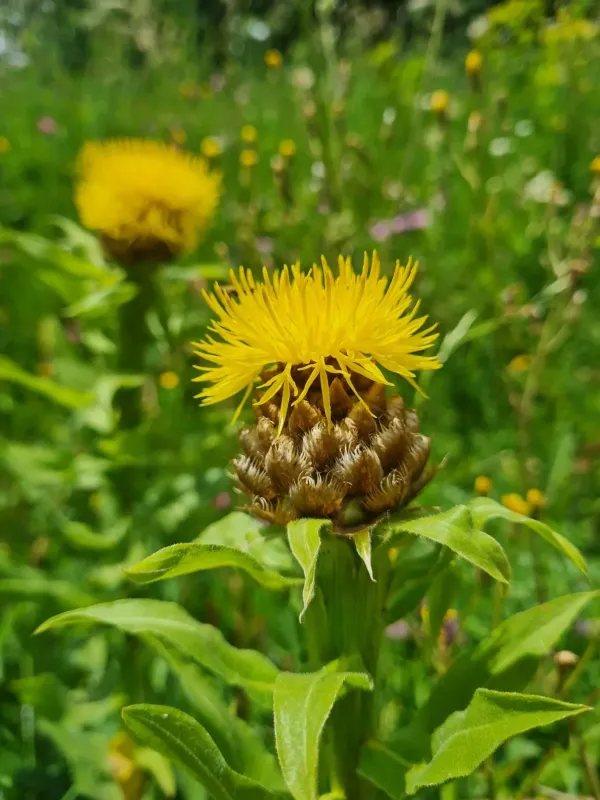
Centaurea macrocephala, commonly known as bighead knapweed, is a perennial herbaceous plant belonging to the Asteraceae family. It typically grows to a height of 120 to 150 centimeters, characterized by a sturdy, upright stem.
The most distinctive feature of this plant is its large, globe-shaped flower heads, which can reach up to 8 centimeters in diameter. These heads are covered in imbricate bracts with fringed, papery appendages, giving the plant a decorative yet rugged appearance.
The leaves are entire, lanceolate, and alternate along the stem. The plant is covered in dense, rough hairs, which enhance its resistance to environmental stress and mechanical damage.
As a perennial, it reproduces via both seeds and an extensive root system. The blooming period usually occurs in late summer, followed by the development of achenes equipped with small, pappus-like structures.
Identifying the plant is relatively simple due to the massive, thistle-like flower heads that set it apart from other common weeds. This visual marker is consistent throughout its growth stages in the field.
Where it grows
Centaurea macrocephala thrives in rich, loamy soils and is frequently found in subalpine meadows, forest clearings, and rocky slopes. It has successfully adapted to disturbed areas, pastures, and roadsides.
In agricultural settings, it is particularly harmful to perennial grass crops used for hay. Its aggressive growth habits allow it to penetrate existing stands, eventually crowding out desirable fodder species.
It also commonly invades grain fields that are adjacent to abandoned lands or wild patches. Its ability to tolerate dry conditions makes it a persistent threat in semi-arid farming regions.
The lack of consistent soil tillage allows the plant to establish deep, established root networks, which are highly resilient. Once established, it can easily dominate local plant communities.
Agricultural fields that have been left fallow for several years are prime candidates for colonization by this weed. It spreads through its dense seed production and vegetative expansion.
Harm it causes
The primary economic damage caused by Centaurea macrocephala is the reduction of pasture and hay quality. The plant's tough stems and spiny bracts make the hay less palatable and potentially harmful to livestock.
As a competitive weed, it consumes significant amounts of nitrogen and soil moisture, causing surrounding crops to suffer from stunted growth and reduced yields due to nutrient competition.
The presence of bighead knapweed seeds in harvested grain is problematic for producers. Due to the shape and size of the seeds, they are difficult to separate from cereal crops using standard industrial cleaning equipment.
It also acts as an alternative host for various pests and fungal diseases, facilitating their spread to neighboring commercial crops and increasing overall phytosanitary management costs.
Ultimately, farmers are forced to invest more in chemical and mechanical interventions, which lowers the overall profitability of the agricultural enterprise and complicates long-term crop management strategies.
How to control
Mechanical control involves deep autumn plowing to uproot the plants and expose the rhizomes to freezing or desiccation. This is one of the most effective ways to manage large infestations without immediate chemical use.
Regular mowing, conducted strictly before the flower buds begin to open, prevents seed production and gradually depletes the energy stored in the root system, eventually leading to plant death.
Implementing crop rotation with intensive row crops allows for frequent inter-row cultivation. This mechanical disruption of the soil is essential for eliminating seedlings and breaking up established root clumps.
Chemical control usually relies on systemic herbicides, such as those based on 2,4-D or dicamba. Treatments are most effective when applied to young, actively growing rosettes in the spring.
To ensure maximum efficacy, the use of surfactants in the herbicide tank mix is recommended. These help the chemical penetrate the densely haired leaves of the plant, ensuring better systemic absorption.
Taxonomy
- Latin name
- Centaurea macrocephala
- Family
- Сложноцветные (астровые)
- EPPO code
- CENMC