
Carline thistle
Carlina vulgaris
Description
How to tell it apart
Carline thistle (Carlina vulgaris) is a member of the Asteraceae family. It is a biennial herb characterized by a rigid, often branched stem.
The leaves are alternate, oblong, and deeply pinnatifid with spine-tipped lobes, creating a defensive barrier that is common for this species.
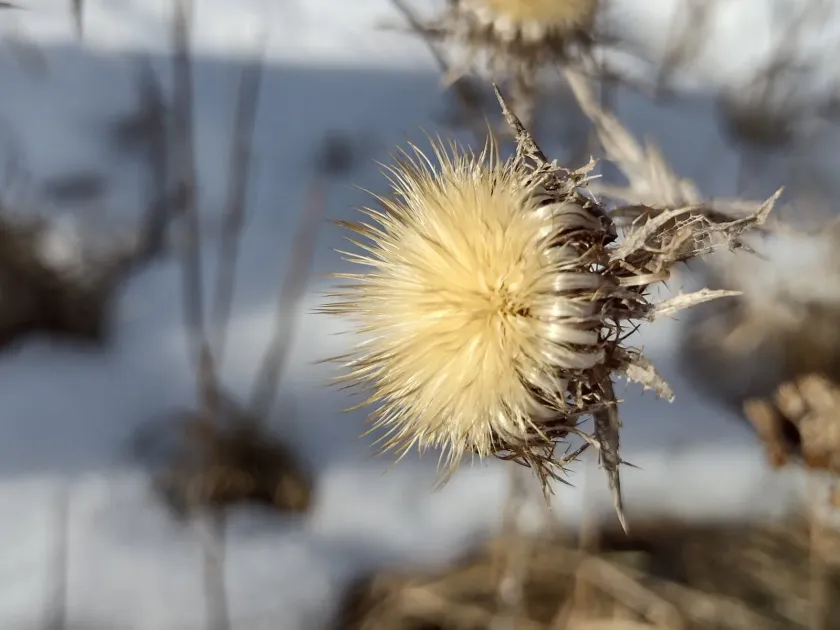
Its inflorescence is a distinct, solitary head surrounded by a whorl of prickly, straw-colored, shiny bracts that look like a metallic star.
The plant possesses a strong taproot, which allows it to thrive in nutrient-poor and dry soil conditions where other species fail.
Reproduction is solely through seed, which is lightweight and adapted for wind dispersal, ensuring colonization of new areas.
Where it grows
This weed typically inhabits dry, sandy, or rocky habitats, including pasture lands, fallow fields, and roadsides across Europe and parts of Asia.
It prefers disturbed sites or areas where the established vegetation cover is sparse, allowing it to compete effectively for space.
Harm it causes
The main impact on crops is competitive; it absorbs significant soil moisture and nutrients, negatively affecting the yield of desired plants.
On livestock pastures, Carline thistle creates unpalatable thickets, reducing the amount of grazing area and interfering with cattle movement.
Seed contamination is a major concern, as the prickly seeds can degrade the quality of harvested grain, necessitating extra processing costs.
How to control
Mechanical control involves cutting or digging out the plants before they reach the flowering stage to prevent seed set.
Effective tillage, including deep plowing, is essential for destroying the root systems of biennial weeds during their first or second year.
Chemical control can be achieved by applying broadleaf herbicides to the rosette stage of the weed, ensuring high uptake of the active ingredient.
Maintaining a dense canopy of cover crops or desired forage species is a natural way to suppress the development of this weed.
Prevention includes the consistent monitoring of field edges and waste areas to eliminate potential seed sources before they spread.
Taxonomy
- Latin name
- Carlina vulgaris
- Family
- Сложноцветные (астровые)
- EPPO code
- CIIVU