
Mexican milkweed
Asclepias mexicana
Description
How to tell it apart
Mexican milkweed (Asclepias mexicana) is a perennial herbaceous plant belonging to the Apocynaceae family. It is characterized by a deep, expansive root system that allows it to survive harsh conditions and regenerate vigorously.
The plant typically grows up to one meter tall with erect stems. Its narrow, lanceolate leaves are arranged in whorls or clusters, which is a key morphological feature for identification in the field.
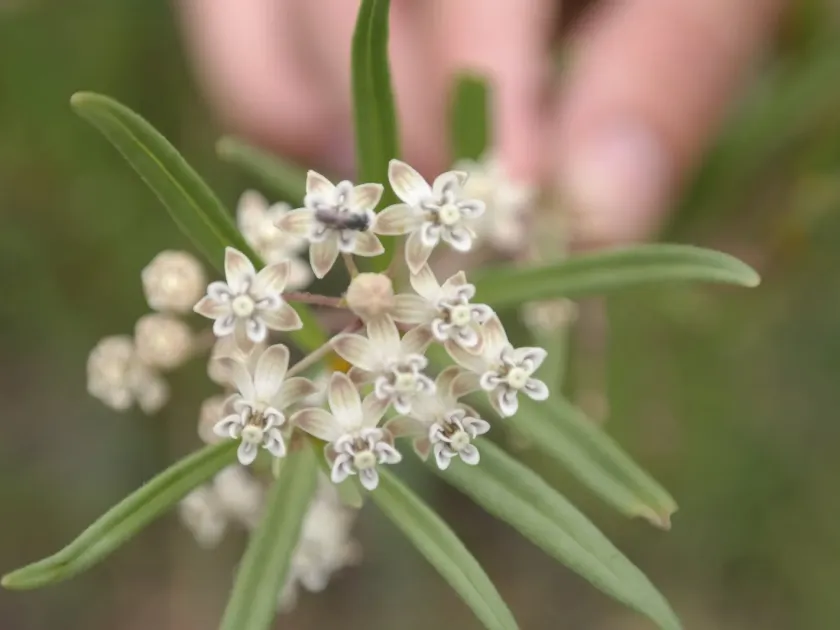
The flowers are arranged in umbel-like clusters and exhibit a white to greenish-cream color. The fruit is a distinctive follicle containing seeds equipped with long white filaments, or coma, for wind dispersal.
All parts of the plant contain a milky, toxic latex that is harmful to livestock. This makes the plant not only a competitive weed but also a significant safety concern in pastures.
Reproduction occurs via both seeds and creeping rhizomes, enabling the plant to establish dense patches that expand rapidly if not managed appropriately.
Where it grows
The species is native to the western parts of North America, particularly in regions across Mexico and the southwestern United States, where it thrives in dry habitats, canyons, and roadsides.
In agricultural settings, it frequently colonizes abandoned fields, rangelands, and the edges of irrigation ditches. Its high drought tolerance allows it to outcompete native or crop vegetation in arid climates.
Mexican milkweed is commonly found in crop fields, disturbed land, and along field borders. It utilizes free space efficiently and spreads quickly via machinery movement between fields.
The plant is highly adaptable to various soil types, provided they are well-drained. It often invades agricultural land from adjacent unmanaged buffer zones or fence lines.
Due to its efficient seed dispersal mechanism, the plant can migrate across large distances, establishing new populations in previously clean agricultural areas.
Harm it causes
The primary concern regarding this weed is its toxicity. It contains cardiac glycosides that are poisonous to livestock, causing severe illness or death if ingested in either fresh or dried form.
As a competitive weed, it siphons essential water and nutrients from the soil, directly inhibiting the growth of cultivated crops and resulting in reduced agricultural yields.
Contamination of harvested forage or hay with this milkweed species can lead to the condemnation of entire batches of feed, causing significant financial losses to farmers.
The extensive and woody root system poses physical challenges for tillage operations, often clogging farm equipment and increasing the mechanical effort required for field preparation.
Dense infestations can lead to the degradation of grazing lands, reducing the nutritional value of pasture and necessitating the exclusion of livestock from affected areas.
How to control
Effective management requires a combination of strategies, starting with deep tillage to expose and dry out the root systems, which is most effective when performed during dry weather.
Repeated mowing of the vegetative growth before the flowering stage is essential to exhaust the plant's energy reserves and prevent seed production, thereby halting further spread.
Systemic herbicides, particularly those containing glyphosate, are effective for controlling the weed in non-crop areas or during fallow periods, though multiple applications are often required.
In selective crop environments, broadleaf-specific herbicides may provide partial control, but long-term success relies on maintaining healthy crop stands to shade out the weed seedlings.
- Regular monitoring of field borders and irrigation infrastructure.
- Cleaning agricultural equipment to prevent seed transport.
- Implementing competitive cover crops to suppress weed establishment.
- Integrating chemical and mechanical control measures annually.
Taxonomy
- Latin name
- Asclepias mexicana
- Family
- Кутровые
- EPPO code
- ASCMX