
Fringed amaranth
Amaranthus fimbriatus
Description
How to tell it apart
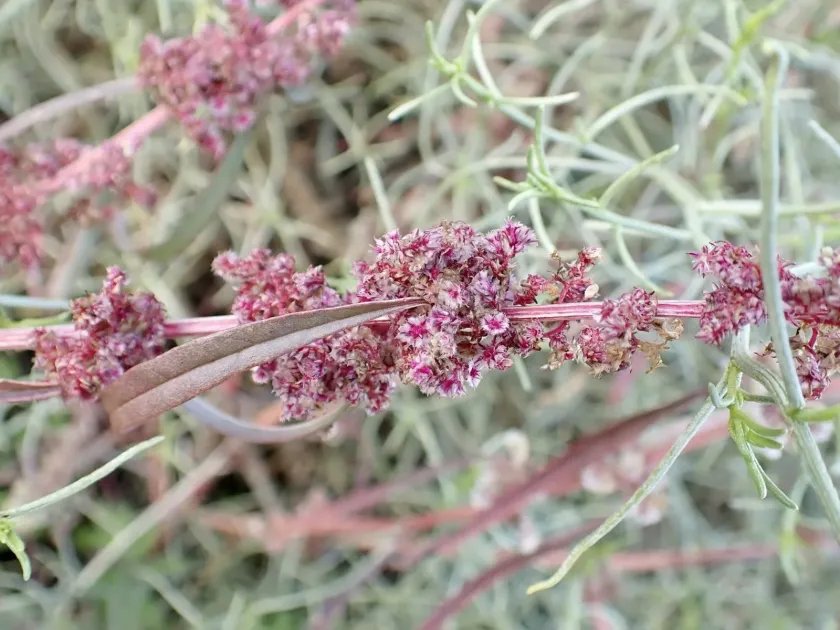
Fringed amaranth (Amaranthus fimbriatus) belongs to the Amaranthaceae family. It is an annual herbaceous plant that typically exhibits a prostrate or slightly ascending stem growth habit.
A distinctive feature of this species is its specific bracts, which have fringed edges, giving the plant its common and scientific name. The leaves are usually alternate, entire, and often feature a wedge-shaped base.
The flowers of this species are very small, arranged in axillary clusters or terminal spike-like inflorescences. The plant's color can vary from light green to reddish depending on the growth stage and environmental conditions.
The root system is a well-developed taproot, allowing the plant to effectively utilize moisture from deeper soil layers, even in arid conditions. Seedlings typically emerge in late spring and early summer as soil temperatures rise.
The seeds are extremely small, black, and possess high longevity in the soil. They are capable of germinating over several years, which makes the complete eradication of this weed particularly challenging for farmers.
Where it grows
Fringed amaranth is a typical representative of xerophilic flora. It is most frequently found in the southwestern United States and northern regions of Mexico, where it prefers open, dry habitats.
In agricultural practice, this plant often infests row crops such as cotton, corn, and sorghum. It poses a significant threat in regions characterized by hot and dry climates where other weeds may be less competitive.
The weed frequently occupies roadsides, abandoned pastures, and wastelands, from which seeds are easily dispersed by wind and agricultural machinery into cultivated fields. It prefers light-textured, well-drained soils.
Its spread in crops is often linked to intensive mechanical field operations, as the small seeds are easily transported by combines and soil tillage equipment. It is highly tolerant to extreme heat.
Amaranth quickly colonizes open field areas after the harvest of early crops, utilizing residual soil moisture for vigorous growth and the replenishment of the soil seed bank.
Harm it causes
The harmfulness of Fringed amaranth lies in its strong competition with cultivated crops for vital resources: water, nutrients, and sunlight during the critical early stages of crop development.
Due to its ability to grow rapidly under moisture-deficient conditions, this weed can significantly reduce crop yields, especially in dry years when every millimetre of rainfall is essential for crop success.
Dense stands of amaranth create a favorable microclimate for the proliferation of pests and the development of pathogenic fungi, which may subsequently spread to crop plants, increasing pesticide application costs.
The presence of this weed in commercial fields complicates the harvesting process, as it can clog combine harvesters and increase the moisture content of the grain due to the plant's late-season green mass.
Furthermore, amaranth has a high potential to rapidly contaminate the soil with seeds, requiring long-term and costly weed management programs in subsequent crop rotation seasons.
How to control
A primary control measure is thorough pre-plant soil tillage aimed at inducing the germination of weed seeds, followed by mechanical destruction of seedlings before the main crop is sown.
In farming systems, crop rotation plays a crucial role; incorporating crops that produce a dense canopy helps suppress weed development by shading the soil surface effectively.
Chemical control strategies include the use of pre-emergence soil herbicides to suppress early flushes of amaranth germination and reduce its competitive pressure on the developing crop.
When necessary, systemic post-emergence herbicides are applied. It is essential to target the correct growth stage: application is most effective at the 2–4 true leaf stage, well before the plant begins forming inflorescences.
- Rigorous cleaning of seeds to prevent the introduction of new weed populations.
- Timely mowing of weeds on field borders and adjacent non-crop areas.
- Implementation of inter-row cultivation in row crops to disrupt weed root systems.
- Rotation of herbicides with different modes of action to prevent the development of herbicide resistance.
Taxonomy
- Latin name
- Amaranthus fimbriatus
- Family
- Амарантовые
- EPPO code
- AMAFI