
Khaki weed
Alternanthera pungens
Description
How to tell it apart
Khaki weed (Alternanthera pungens) is a prostrate, mat-forming herbaceous perennial belonging to the Amaranthaceae family. Its stems are typically creeping, rooting at the nodes, which allows it to cover large areas of the soil surface.
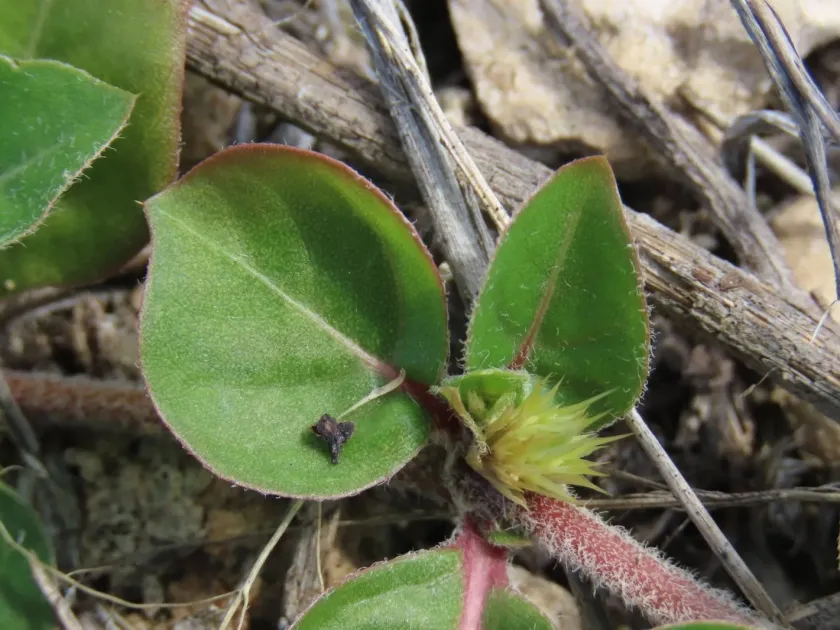
The most distinctive feature of this plant is its sharp, spiny bracts located in the leaf axils. These spines are extremely rigid when mature, providing the plant with an effective defense mechanism against herbivores.
The leaves are opposite, varying from lanceolate to rhombic, and often possess a slightly pubescent texture. This structure helps the plant thrive in sunny, dry environments by reducing water loss through transpiration.
Flowering occurs in dense, head-like clusters that turn brown and prickly upon ripening. The small, inconspicuous flowers are often overlooked until the seed heads develop their characteristic sharp, defensive structures.
Its root system is robust and capable of surviving in various soil conditions. The plant is difficult to eradicate manually because even small segments of the stem, if left in the soil, can produce new roots and re-establish the colony.
Where it grows
Khaki weed is a common invader of disturbed sites, including roadsides, path verges, parking areas, and overgrazed pastures. It prefers open, sunlit areas with compacted soil where competition from taller vegetation is limited.
In agricultural settings, it is a significant nuisance in row crops, vineyards, and vegetable farms. Its ability to spread via seeds and vegetative parts makes it a frequent contaminant in agricultural machinery and irrigation water.
The weed exhibits high environmental plasticity, allowing it to colonize both nutrient-poor and fertile soils. It is particularly aggressive in hot, arid to semi-arid regions where other vegetation might struggle, but it can also survive in temperate climates.
Seed dispersal is largely aided by human activity and animal movement. The spiny burrs easily attach to tires, animal fur, and footwear, facilitating the rapid spread of the species across large geographical distances.
It often acts as a pioneer species in degraded landscapes, creating dense mats that prevent the natural succession of native plants. Once established, it can persist for many years, creating a permanent seed bank in the soil.
Harm it causes
The primary agricultural impact of Khaki weed is its strong competition for water and nutrients. Its dense mat growth effectively chokes out crop seedlings, leading to reduced yields and stunted growth in various agricultural crops.
It poses a serious health risk to livestock. When present in fodder or grazing land, the sharp spines can cause painful injuries to the mouths and tongues of animals, leading to secondary infections, ulcers, and decreased feed intake.
The presence of Khaki weed creates significant labor challenges. Field workers often suffer from painful pricks while weeding or harvesting, which slows down operational efficiency and increases the cost of manual labor.
The aesthetic and utility value of recreational areas and public paths is severely diminished by the presence of this weed. Its spines make these areas unusable for barefoot activities or recreational purposes.
Invasion by Khaki weed can lead to the displacement of native flora, reducing the biodiversity of the local ecosystem. This reduction in botanical variety can negatively affect the overall health and stability of the soil and local habitats.
How to control
Effective management of Khaki weed requires an integrated approach that combines preventive measures, mechanical cultivation, and targeted chemical control. Long-term success depends on exhausting the seed bank.
Mechanical control involves deep ploughing and regular hoeing to prevent the plant from establishing a firm root system. However, care must be taken to remove plant debris, as stems left on the ground can easily re-root if moisture is present.
Chemical control is most effective when herbicides are applied during the active growth phase before seed heads have hardened. Systemic herbicides are preferred to ensure that the chemical is transported to the roots, preventing regrowth.
Preventive measures include strict sanitation of farm machinery when moving between infested and clean areas. Encouraging healthy ground cover in pastures can also prevent the weed from finding the bare, compacted soil it needs to colonize.
- Regular site monitoring for early detection
- Deep tillage and mechanical cultivation
- Targeted application of systemic herbicides
- Sanitation of equipment to prevent seed movement
- Maintaining competitive crop cover to suppress germination
Taxonomy
- Latin name
- Alternanthera pungens
- Family
- Амарантовые
- EPPO code
- ALRRE