
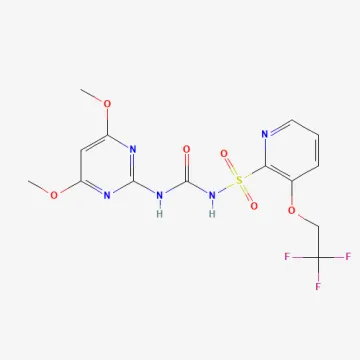
Trifloxysulfuron
Description
Mode of action
Trifloxysulfuron belongs to the sulfonylurea chemical class and is a highly effective systemic herbicide used for controlling a broad spectrum of unwanted vegetation.
Its mechanism of action is based on inhibiting the acetolactate synthase (ALS) enzyme in plants, which leads to an immediate halt in cell division.
Once it reaches the leaves and roots, the substance rapidly translocates through the phloem and xylem to the weed's growing points, causing chlorosis and subsequent tissue necrosis.
The active ingredient inhibits the biosynthesis of essential amino acids, such as valine, leucine, and isoleucine, making it a highly selective and powerful agronomic tool.
Unlike contact products, trifloxysulfuron provides deep penetration into the weed's root system, preventing regrowth after application.
What it targets
This substance is effectively used for eliminating many species of broadleaf weeds, including the most difficult-to-control perennial types.
Trifloxysulfuron shows particular efficiency in fighting weeds such as thistle species, knotweed, as well as certain types of ragweed and amaranth.
It successfully controls weeds in cotton crops, sugarcane, and on turf where high herbicide selectivity is required.
The application of the product reduces competition for nutrients and moisture between crops and weeds during early growth stages, directly impacting final yields.
The substance exhibits high biological activity even at very low application rates, which minimizes the pesticide load on the soil environment.
Rates and timing
The application rates of trifloxysulfuron depend on the specific crop being cultivated, the level of field infestation, and the growth stage of the weeds at the time of spraying.
The most effective method is application on actively growing weeds at the cotyledon or early true-leaf stage.
Strict adherence to temperature requirements during application is crucial, as the efficacy of sulfonylureas decreases under extreme heat or cold.
Working solutions must be prepared immediately before use, utilizing clean water that meets requirements for hardness and pH levels.
In modern agricultural practices, tank mixes are frequently used to broaden the spectrum of control, provided that physical compatibility of the components is verified beforehand.
Restrictions
Trifloxysulfuron possesses distinct soil activity and high persistence, necessitating strict adherence to crop rotation schemes on treated fields.
It is not recommended to perform treatments if rainfall is expected within a few hours post-application, as this reduces the absorption efficiency of the product.
Operators should avoid spray drift to neighboring sensitive crops by using appropriate nozzles and monitoring wind speed on the day of application.
The product should not be applied to weakened or pest-damaged plants to avoid significant phytotoxic effects on the crop itself.
To prevent the development of weed resistance, it is advised to rotate the use of trifloxysulfuron with herbicides that possess different mechanisms of action.
Status in the European Union
Not approved in the EU
- CAS number
- 145099-21-4
EU status is for reference only and does not replace national registration in your country.