
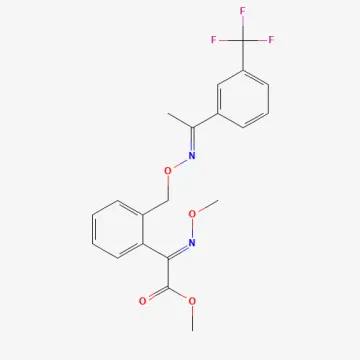
Trifloxystrobin
Description
Mode of action
Trifloxystrobin belongs to the strobilurin chemical class and is a synthetic analog of natural substances produced by certain fungi. It is a mesostemic active ingredient with the unique ability to redistribute across the leaf surface through the formation of a vapor phase.
The mode of action is based on blocking the mitochondrial respiration of pathogens. The substance inhibits electron transport in complex III, leading to a rapid cessation of energy (ATP) production in fungal cells and their subsequent death.
Due to its high lipophilicity, trifloxystrobin binds firmly to the waxy layer of leaves, providing exceptional resistance to wash-off by rain. This property allows the preparation to effectively protect both treated and newly growing parts of the plant.
The substance exhibits a strong preventive effect, hindering spore germination and the penetration of mycelium into plant tissues. It also possesses curative effects by suppressing mycelial development during the early stages of infection.
Trifloxystrobin is frequently used in tank mixes or combination products to expand the spectrum of activity and prevent the development of resistance in pathogens. It is often combined with triazoles to enhance and extend the protective effect.
What it targets
This substance is effective against a broad spectrum of pathogens from the classes of Ascomycetes, Basidiomycetes, and Deuteromycetes. It is successfully used to control diseases such as powdery mildew, scab, leaf spots, and rusts.
In cereal crops, trifloxystrobin controls the development of Septoria, Pyrenophora, and net blotch. In fruit crops, such as apples, it is a key component for protection against scab and powdery mildew.
Vineyards are protected with this substance against powdery mildew (Oidium), which is critical for maintaining the marketability and quality of the harvest. The preparation is also effective against various types of rots and molds affecting vegetable crops.
It is recommended to apply the preparation at the first signs of disease or preventively during periods of high epiphytotic risk. Timely application helps avoid mass infection of fields and significant yield losses.
It is important to consider that to prevent the emergence of resistant fungal populations, treatments with trifloxystrobin must be alternated with fungicides from other chemical groups with different modes of action.
Rates and timing
Dosage rates depend on the crop type, disease pressure, and growth stage. On average, for field crops, they range from 100 to 250 grams per hectare calculated based on the formulated product.
The timing of applications is linked to critical plant growth stages. For example, in cereals, this includes tillering and stem elongation; in apples, the period from flowering to fruit formation.
To achieve maximum biological efficacy, it is recommended to conduct spraying in the morning or evening under favorable weather conditions. Application is not advised during extremely high temperatures or strong winds.
The number of treatments per season is usually limited to two or three applications. This is dictated by the need to manage resistance and comply with environmental regulations regarding residue levels in produce.
Before preparing the spray solution, it is essential to carefully read the label of the specific product, as the presence of surfactants or other active ingredients in the formulation may alter recommended dosages and application guidelines.
Restrictions
Trifloxystrobin is moderately toxic to mammals, so it is necessary to use personal protective equipment during handling: protective clothing, gloves, respirators, and safety goggles.
The product can exhibit toxicity to aquatic organisms; therefore, it is prohibited to perform treatments in the sanitary zones of water bodies and to allow spray residues to enter water sources.
Particular attention should be paid to protecting bees. Despite low insecticidal activity, it is recommended to avoid direct contact with honeybees and to carry out treatments during hours when their flight is restricted.
Products based on this substance should be stored in dry, cool rooms out of reach of children and pets. Storage together with food, animal feed, or fertilizers is not permitted.
After finishing the work cycle, it is necessary to thoroughly wash the spraying equipment according to instructions to eliminate the risk of phytotoxicity during subsequent applications of other agrochemicals.
Status in the European Union
Approved in the EU
- CAS number
- 141517-21-7
- Approved from
- 01.08.2018
- Approval until
- 31.07.2033
- ADI
- 0.1 mg/kg bw/day
- ARfD
- 0.5 mg/kg bw
- AOEL
- 0.06 mg/kg bw/day
EU status is for reference only and does not replace national registration in your country.