
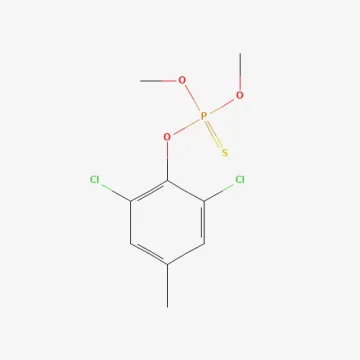
Tolclofos-methyl
Description
Mode of action
Tolclofos-methyl is a specialized organophosphorus fungicide that functions by inhibiting the growth and development of various fungal pathogens.
Its primary mechanism of action involves disrupting the synthesis of phospholipids within fungal cell membranes, which prevents the proper division and growth of the hyphae.
The compound acts as a contact-local systemic agent, providing a durable protective barrier around seeds and roots against pathogens residing in the soil.
It is particularly effective at arresting the early stages of infection, preventing the spread of diseases during the crucial germination and seedling establishment phases.
The chemical stability of tolclofos-methyl ensures long-lasting activity in the soil, which helps maintain plant health throughout the initial weeks of development.
What it targets
The substance is primarily used to control fungal diseases that are transmitted through the soil or on the surface of plant materials like seeds and tubers.
- Rhizoctonia solani (black scurf in potatoes).
- Sclerotinia species (white mold).
- Fusarium root rots.
- Typhula blight in winter crops.
- Various damping-off diseases caused by soil-borne fungi.
Targeting these specific pathogens helps farmers prevent crop failure and ensures a more uniform stand emergence across the field.
Because it is highly specific to certain types of soil-borne fungi, it is often preferred in programs where other fungicides may show limited efficacy.
Effective management of these targets leads to healthier root systems, which significantly contributes to overall plant vigor and higher final yield potential.
Rates and timing
Application rates for tolclofos-methyl are highly specific to the crop type and the mode of delivery, whether applied as a seed treatment or in-furrow during planting.
When treating potato tubers or seeds, it is critical to achieve complete coverage to ensure that every part of the planting material is protected from potential infection.
Adherence to recommended dosage levels is vital to avoid potential phytotoxicity and to comply with agricultural safety regulations for the specific crop.
Timing is usually focused on the pre-planting phase to establish an active shield that protects the developing plant as soon as germination begins.
Proper calibration of spraying equipment is necessary to ensure the uniform distribution of the fungicide across the target area, optimizing its chemical activity.
Restrictions
Users must wear appropriate personal protective equipment (PPE), including gloves and respiratory protection, to avoid any dermal or inhalation exposure during handling.
Mixing tolclofos-methyl with highly alkaline substances should be avoided, as this may lead to chemical instability and a significant reduction in fungicidal efficacy.
Care should be taken during application to prevent runoff into aquatic ecosystems, as the substance may pose risks to water-dwelling organisms.
Storage must be conducted in the original, labeled packaging within a cool, dry, and well-ventilated area, securely separated from food and feedstuffs.
After application, all equipment must be thoroughly cleaned according to best practices to prevent cross-contamination and to maintain the longevity of the machinery.
Status in the European Union
Approved in the EU
- CAS number
- 57018-04-9
- Approved from
- 01.09.2019
- Approval until
- 31.08.2034
- ADI
- 0.064 mg/kg bw/day
- ARfD
- 0.14 mg/kg bw
- AOEL
- 0.064 mg/kg bw/day
EU status is for reference only and does not replace national registration in your country.