
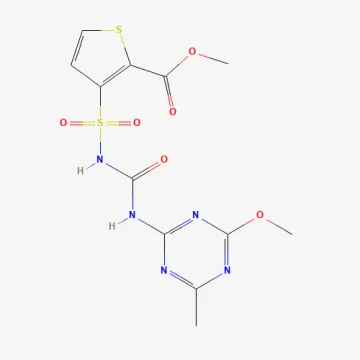
Thifensulfuron-methyl
Description
Mode of action
Thifensulfuron-methyl is a systemic herbicide belonging to the sulfonylurea chemical family, designed to control a wide range of broadleaf weeds.
The product acts by inhibiting the acetolactate synthase (ALS) enzyme, which is essential for the biosynthesis of branched-chain amino acids such as valine, leucine, and isoleucine.
Upon application, the herbicide is rapidly absorbed by the plant foliage and roots, subsequently translocating to the meristematic tissues where plant growth occurs.
The inhibition of cell division leads to the cessation of weed growth shortly after treatment, followed by the development of chlorosis and eventual necrosis of the plant.
Environmental conditions, particularly temperature and moisture, play a crucial role in the speed of the herbicidal activity and the final efficacy of the treatment.
What it targets
The substance is primarily used for selective post-emergence control of various broadleaf weed species in agricultural settings.
It is effective against common weeds such as pigweed, common lambsquarters, wild mustard, and various smartweed species found in crop fields.
Major crops where this herbicide is safely applied include winter and spring cereals (wheat, barley, oats), as well as soybeans and maize.
It does not provide adequate control against grass weeds, necessitating the use of tank mixtures with other herbicides to achieve broad-spectrum weed control.
The high selectivity for crops is due to their metabolic ability to rapidly degrade the herbicide molecule into non-phytotoxic metabolites.
Rates and timing
The application rates typically range from 15 to 50 grams of active ingredient per hectare, depending on the weed spectrum and growth stages.
For best results, applications should target small, actively growing weeds, generally within the cotyledon to four-leaf growth stage.
In cereal crops, the application window usually opens at the two-leaf stage and extends until the crop begins to form the first node.
The addition of a non-ionic surfactant is highly recommended to improve leaf surface wetting and increase the uptake of the active ingredient.
Applications are most effective under favorable growing conditions with temperatures ranging between 10°C and 25°C to ensure optimal physiological activity.
Restrictions
It is strongly advised to avoid application if the crop is under stress caused by drought, frost, nutrient deficiency, or pest infestation.
Mixing thifensulfuron-methyl with organophosphate insecticides should be avoided, as this interaction can increase the risk of crop injury.
Proper water quality is essential; high alkalinity or incorrect pH levels in the spray tank can lead to rapid degradation of the herbicide before application.
Crop rotation plans should consider potential carryover effects, although thifensulfuron-methyl generally dissipates relatively quickly under most soil conditions.
To mitigate the development of weed resistance, it is important to alternate this herbicide with products that have different modes of action.
Status in the European Union
Approved in the EU
- CAS number
- 79277-27-3
- Approved from
- 01.11.2016
- Approval until
- 31.10.2031
- ADI
- 0.01 mg/kg bw/day
- ARfD
- 2.0 mg/kg bw
- AOEL
- 0.07 mg/kg bw/day
EU status is for reference only and does not replace national registration in your country.