
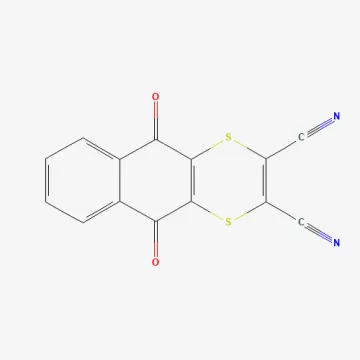
Dithianon
Description
Mode of action
Dithianon belongs to the quinone chemical class and serves as a highly effective contact fungicide with protective properties. The active ingredient does not penetrate plant tissues; instead, it forms a persistent protective film on the surface of treated foliage and fruit, preventing the germination of fungal spores.
The mechanism of action involves inhibiting fungal cellular respiration by disrupting the metabolism within the mitochondria of pathogenic microorganisms. By blocking vital enzymatic systems, the substance ensures the total deactivation of fungal spores before they can initiate infection in the host plant.
A key technical advantage is its excellent rainfastness, which provides a durable protective effect, lasting up to 7–10 days under favorable conditions. The compound remains active even in high-humidity environments, a critical factor when the risk of fungal infection is at its seasonal peak.
Dithianon lacks systemic or curative action, making thorough coverage of all leaf and fruit surfaces essential for the agronomist. The efficacy of the treatment is directly dependent on the precision of the application, as the active ingredient functions strictly through direct contact with the pathogen.
Because the substance is less prone to inducing cross-resistance in fungi, it is a valuable tool for anti-resistance management programs. It is frequently incorporated into tank mixes with systemic fungicides to broaden the protection spectrum and prevent the emergence of fungicide-resistant fungal strains.
What it targets
The primary use of Dithianon is the protection of pome and stone fruit crops against a diverse range of fungal diseases. It is most recognized for its superior performance against apple and pear scab, which remains the most destructive pathogen in intensive commercial orchards.
The fungicide also demonstrates high activity against a wide variety of other pathogens, including:
- Shot-hole disease (stigmina carpophila) on stone fruits.
- Monilinia fruit rot and coccomyces leaf spot.
- Rust and various leaf spotting diseases.
- Peach leaf curl during the early spring development stages.
Due to its specific protective nature, Dithianon is typically deployed as a preventive treatment during periods of high infection risk, such as early vegetative stages or during prolonged wet weather. It effectively suppresses the spread of primary inoculum that has overwintered on plant debris.
Beyond orchards, the active ingredient can be utilized in vineyards to control anthracnose and downy mildew. However, its primary economic significance lies in intensive fruit production, where maintaining the marketability of fruit free from fungal damage is of paramount importance.
The use of this fungicide helps avoid necrosis and deformities on fruit surfaces, which is critical for achieving high-grade produce. Regular applications allow for the management of pathogen populations at levels that prevent significant economic damage to the annual yield.
Rates and timing
Application rates for Dithianon vary depending on the crop, growth stage, and the intensity of the disease pressure in the field. For commercial orchard settings, professionals typically use spray concentrations that ensure uniform wetting of the canopy until runoff occurs.
The timing of applications is linked to the phenological development of the plants and weather forecasts. Preventive spraying begins at the green-tip stage and continues until fruit maturation, strictly adhering to the recommended pre-harvest intervals stipulated by the regulatory guidelines.
Frequency of application throughout the season is a critical consideration. To prevent the accumulation of residues and minimize resistance risks, it is advised to rotate Dithianon with fungicides from different chemical classes throughout the spray program.
When preparing tank mixes, compatibility must be assessed to prevent precipitation or potential phytotoxicity. Dithianon generally integrates well with most modern fungicides but should not be combined with highly alkaline substances or certain copper-based formulations.
The dosage is determined based on the total spray volume required for complete canopy coverage. In cases of high humidity and ongoing epiphytotic threats, the number of applications may be adjusted by the agronomist based on continuous monitoring of the orchard's health status.
Restrictions
Dithianon is classified as a moderately hazardous compound to humans; therefore, the use of appropriate personal protective equipment (PPE) for the skin and respiratory system is mandatory during all handling and field application procedures to avoid irritation from dust or aerosols.
The active substance is toxic to aquatic life. It is strictly prohibited to allow residues or cleaning water to enter natural water bodies, drainage systems, or irrigation networks. Buffer zones must be maintained when applying the product near aquatic environments or fisheries.
Spraying during the flowering period is generally discouraged during peak bee activity hours. While the substance is relatively safe for insects, direct contact with concentrated spray solutions should be avoided. Optimal application times are during the early morning or evening hours.
Strict adherence to pre-harvest intervals is required, typically ranging from 20 to 30 days depending on local regulations. This ensures that any residual fungicide levels in the harvested fruit remain well below the legally established maximum residue limits (MRLs).
Products containing Dithianon should be stored in original, labeled packaging in a cool, dry area inaccessible to unauthorized personnel and animals. Disposal of containers and leftover spray mixtures must comply with local waste management regulations for agricultural chemicals.
Status in the European Union
Approved in the EU
- CAS number
- 3347-22-6
- Approved from
- 01.06.2011
- Approval until
- 31.01.2027
- ADI
- 0.01 mg/kg bw/day
- ARfD
- 0.12 mg/kg bw
- AOEL
- 0.0135 mg/kg bw/day
EU status is for reference only and does not replace national registration in your country.